
Challenge Overview#
- Challenge name: HTTP request smuggling, basic CL.TE vulnerability
- Category: HTTP Request Smuggling
- Level: Practitioner
- Objective: Exploit a front-end and back-end desynchronization using the CL.TE request smuggling technique to alter the subsequent request forwarded to the back-end, mutating its method to
GPOSTand eliciting a 403 Forbidden response.
1. Core Fundamentals#
HTTP Request Smuggling is a critical application-layer vulnerability arising from discrepancies in message boundary delimitation between intermediate reverse proxies and backend application servers.
1.1. Reverse Proxy Chain Architecture and Connection Reuse#
- Multi-Tier Model: Modern web architectures commonly deploy a reverse proxy chain consisting of a Front-end server (Reverse Proxy, Load Balancer, CDN, or WAF) and a Back-end server (internal application server).
- Connection Pooling and Reuse: To optimize network performance and reduce TCP/TLS handshake overhead, the front-end maintains persistent, long-lived TCP connections to the back-end (HTTP Keep-Alive / Connection Reuse). Incoming HTTP requests from disparate clients are multiplexed sequentially across these shared TCP streams to the back-end.
1.2. HTTP/1.1 Message Framing and Delimitation Mechanics#
Under RFC 7230, the HTTP/1.1 protocol provides two primary headers to demarcate message body boundaries:
- Content-Length: Explicitly indicates the size of the message body in octets (bytes).
- Transfer-Encoding: When configured to
chunked, the message body is split into a series of chunks. Each chunk begins with its size represented in hexadecimal, followed by a CRLF (\r\n), the chunk data, and terminates with a zero-length chunk (0\r\n\r\n). - Conflict Resolution under RFC 7230: Section 3.3.3 of RFC 7230 specifies that if a message contains both
Content-LengthandTransfer-Encoding, theTransfer-Encodingheader MUST take precedence and theContent-Lengthheader MUST be ignored to prevent request routing discrepancies.
1.3. The CL.TE Desynchronization Primitive#
A CL.TE vulnerability occurs when there is an implementation discrepancy regarding RFC compliance between proxy layers:
- Front-end Behavior: The front-end prioritizes the
Content-Lengthheader and ignores or does not supportTransfer-Encoding. - Back-end Behavior: The back-end complies with RFC specifications, prioritizing
Transfer-Encoding: chunked.
Consequently, the front-end forwards the entire payload based on the byte count in Content-Length, whereas the back-end terminates parsing at the terminating zero-chunk, leaving unparsed bytes lingering in the TCP connection’s socket buffer.
2. Attack Architecture / Threat Model#
The CL.TE attack pattern involves injecting a partial request prefix into the body of an initial request. The back-end treats this leftover data as the start of the next incoming request on the shared TCP connection.
| |
2.1. Attack Execution Flow#
- Step 1 - Dispatching the Poisoning Request: The attacker crafts an HTTP POST request specifying both
Content-Length: 6andTransfer-Encoding: chunked. The request body includes the terminating chunk0\r\n\r\nfollowed by a smuggled prefix characterG. - Step 2 - Front-end Forwarding: The front-end evaluates the body length as exactly 6 bytes (including chunk 0 and character G) per the
Content-Lengthheader, treats the request as valid, and forwards all 6 bytes across the pooled TCP connection. - Step 3 - Back-end Chunk Parsing: The back-end parses the payload using
Transfer-Encoding: chunked. Upon encountering0\r\n\r\n, it marks the first request as complete and returns anHTTP/1.1 200 OKresponse. - Step 4 - Buffer Remainder: The remaining unparsed character
Gis not discarded; it remains buffered in the back-end’s TCP socket receive queue. - Step 5 - Request Mutation: When the next HTTP request (e.g.,
POST / HTTP/1.1) is processed on the same connection, the back-end reads from the socket buffer starting withG, prepending it to the incoming request line to formGPOST / HTTP/1.1. - Step 6 - Triggering the Error Response: The back-end fails to recognize
GPOSTas a valid HTTP verb and rejects the request with a403 Forbiddenstatus code accompanied by an invalid method error message.
2.2. Root Cause and Vulnerability Preconditions#
- Root Cause 1: The front-end violates RFC 7230 section 3.3.3 by failing to prioritize
Transfer-EncodingoverContent-Length. - Root Cause 2: The front-end transparently relays conflicting framing headers without sanitization, normalization, or early rejection at the perimeter.
- Root Cause 3: The infrastructure multiplexes independent client sessions across persistent back-end TCP connections without session-level or request-level isolation barriers.
3. Vulnerability Exploitation#
The exploitation process was conducted using Burp Suite Repeater to demonstrate request method mutation via CL.TE smuggling.
3.1. Baseline HTTP Traffic Analysis#
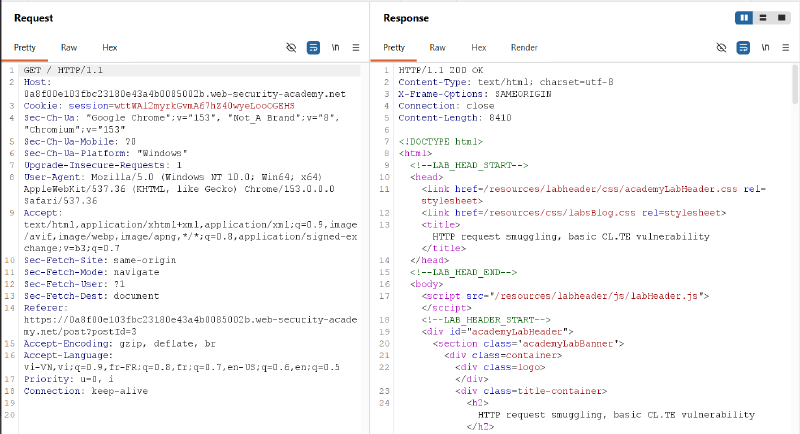
Capturing a standard GET / HTTP/1.1 request targeting the application’s root endpoint and analyzing the response via Burp Suite Repeater:
| |
The application functions normally, returning an HTTP/1.1 200 OK status code alongside the HTML content of the homepage.
3.2. Crafting the CL.TE Desynchronization Payload#
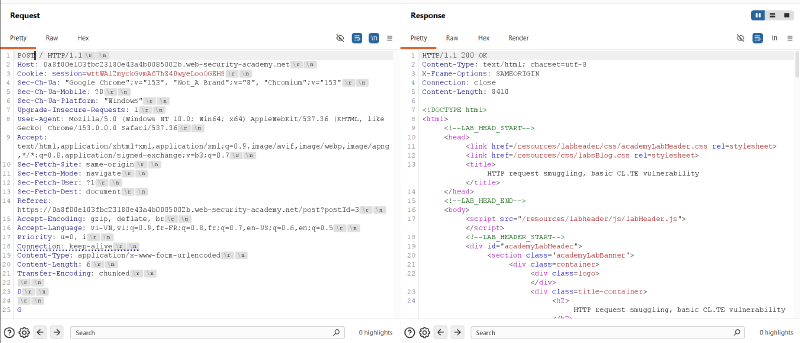
Switch the request method to POST, disable the automatic Update Content-Length option in Burp Suite Repeater, and configure dual framing headers:
Burp Repeater Protocol Configuration:
Although the lab infrastructure supports HTTP/2, classic CL.TE exploitation relies on direct interaction with textual HTTP/1.1 headers. Ensure the protocol is explicitly set to HTTP/1.1 under Request attributes in Burp Repeater’s Inspector tab, and uncheck Update Content-Length from the Repeater menu to lock the body length at 6 bytes.
The front-end server does not support chunked encoding (defaulting to Content-Length) and enforces an access rule permitting only GET and POST methods.
| |
Payload structure breakdown:
- Terminating Chunk: The character
0accounts for 1 byte. - CRLF Delimiters: Two consecutive CRLF line breaks (
\r\n\r\n) account for 4 bytes. - Smuggled Prefix: The smuggled character
Gaccounts for 1 byte. - Total Byte Length: The exact body length equals
1 + 2 + 2 + 1 = 6bytes, matchingContent-Length: 6.
Dispatching the first request yields an HTTP/1.1 200 OK response because the back-end processes the terminating chunk 0 and fulfills the initial request, leaving G lingering in the TCP connection buffer.
3.3. Smuggling the Payload and Triggering Method Poisoning#
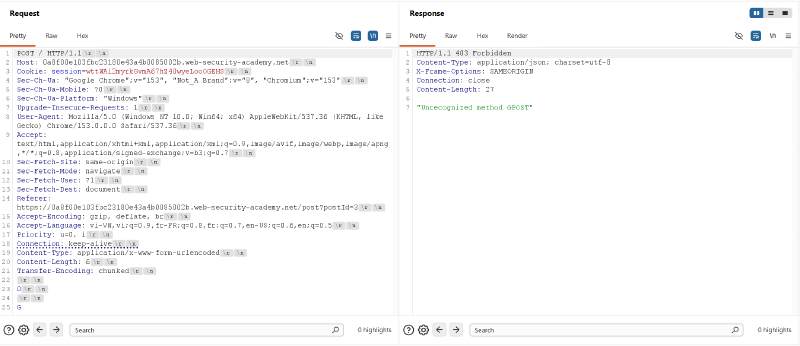
Send a second request immediately across the same TCP connection. The back-end consumes the lingering G from its socket buffer, prepending it to the incoming request line:
| |
The back-end identifies the method as GPOST—an invalid HTTP verb—and returns a 403 Forbidden response containing error details in the JSON body:
| |
3.4. Challenge Completion Verification#
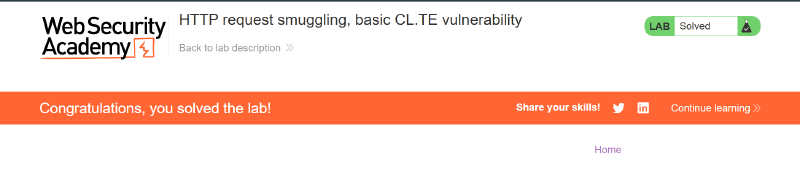
Once the mutated GPOST request is processed by the back-end server, the Web Security Academy platform confirms the CL.TE vulnerability and marks the challenge as solved.
4. Remediation Strategies#
To eliminate CL.TE HTTP Request Smuggling vulnerabilities, defense-in-depth architectural and configuration controls must be applied:
4.1. End-to-End HTTP/2 Implementation#
- Binary Framing Layer: Deploy HTTP/2 end-to-end (Client-to-Front-end and Front-end-to-Back-end). HTTP/2 uses binary framing where frame lengths are explicitly declared within binary headers, entirely removing the ambiguity of textual
Content-LengthandTransfer-Encodingparsing. - Avoid Protocol Downgrades: Prohibit protocol downgrading from HTTP/2 at the reverse proxy to HTTP/1.1 at the backend, as header translation is a frequent source of desynchronization flaws.
4.2. Front-End Header Normalization and Sanitization#
- Reject Ambiguous Requests: Configure the reverse proxy to strictly inspect incoming requests. If a request provides both
Content-LengthandTransfer-Encoding, reject it immediately with anHTTP 400 Bad Requestinstead of attempting heuristic resolution. - Message Normalization: When forwarding requests to legacy backend services, normalize messages into a single canonical format (e.g., dechunking the payload and recalculating an authoritative
Content-Lengthheader) before transmission.
4.3. Secure Connection Pooling and Backend Hardening#
- Server Software Parity: Standardize HTTP server implementations, versions, and parsing libraries across proxy and application tiers to ensure uniform RFC 7230 compliance.
- Connection Pool Isolation: Limit backend TCP connection reuse or enforce strict connection isolation per user session to prevent lingering data in socket buffers from affecting subsequent client requests.