
Challenge Overview#
- Challenge name: HTTP request smuggling, basic TE.CL vulnerability
- Category: HTTP Request Smuggling
- Level: Practitioner
- Objective: Exploit a TE.CL desynchronization flaw to smuggle an arbitrary request prefix, causing the subsequent request processed by the back-end to mutate into an invalid
GPOSTmethod and trigger a 403 Forbidden response.
1. Core Fundamentals#
The TE.CL variant of HTTP Request Smuggling is the inverse of the CL.TE vulnerability. It arises from conflicting message boundary delimitation precedence within a multi-tiered web server architecture.
1.1. Multi-Tier Server Architecture and Message Boundary Delimitation#
- Reverse Proxy Relaying: In modern stream-relaying architectures, a front-end server (such as Nginx, HAProxy, Envoy, or a CDN) accepts client HTTP requests and forwards them to a back-end server (such as Apache HTTP Server, Node.js, or Tomcat) across persistent internal TCP connections to optimize throughput and reduce latency.
- Message Framing Standards: RFC 7230 defines two core mechanisms to demarcate the boundaries of an HTTP/1.1 message body: the
Content-Lengthheader specifies an exact byte count, whileTransfer-Encoding: chunkeddefines dynamically framed chunks terminating with a zero-length chunk (0\r\n\r\n).
1.2. Anatomy of the TE.CL Vulnerability#
- Precedence Discrepancy: A TE.CL vulnerability occurs when the front-end prioritizes
Transfer-Encoding: chunked, whereas the back-end ignores or fails to supportTransfer-Encodingand falls back to evaluatingContent-Length. - RFC 7230 Conflict Clause: Under RFC 7230 section 3.3.3, if both headers are present in a request,
Transfer-Encodingmust strictly overrideContent-Length. When the back-end fails to adhere to this rule due to implementation quirks or configuration errors, desynchronization occurs.
1.3. Establishing the Desynchronization State#
- Front-end Parsing: The front-end reads through all chunked blocks until it reaches the terminating chunk
0\r\n\r\n, deems the message complete, and forwards the entire byte sequence over the pooled connection. - Back-end Parsing: The back-end inspects only the small byte count specified by
Content-Length, processes that prefix as the entire request body, and closes the request transaction. The remaining unread bytes—belonging to the forwarded chunk payload—linger unconsumed in the TCP socket’s receive buffer.
2. Attack Architecture / Threat Model#
The TE.CL attack model leverages the front-end’s willingness to forward a large chunked body containing an embedded request, while the back-end truncates its read based on a small Content-Length, leaving the smuggled payload queued in the TCP buffer.
| |
2.1. Attack Execution Flow#
- Step 1 - Dispatching the Poisoning Request: The attacker transmits an HTTP POST request declaring both
Content-Length: 4andTransfer-Encoding: chunked. The body contains a chunk length of5a(90 bytes in decimal), followed by the complete prefix of the smuggled requestGPOST / HTTP/1.1, ending with the terminating chunk0\r\n\r\n. - Step 2 - Front-end Forwarding: The front-end parses the message via
Transfer-Encoding: chunked, processes chunk5aand terminating chunk0, considers the message structurally valid, and forwards the entire byte sequence to the back-end. - Step 3 - Truncated Read on Back-end: The back-end evaluates
Content-Length: 4, consuming only the first 4 bytes of the body (5a\r\n). It concludes request parsing, processes the request, and returns anHTTP/1.1 200 OKresponse. - Step 4 - Smuggled Request in Socket Buffer: The unconsumed byte stream beginning with
GPOST / HTTP/1.1...remains buffered in the back-end’s TCP socket receive queue. - Step 5 - Next Request Mutation: When the next client request arrives on this shared connection, the back-end reads from the socket buffer first. The buffered
GPOST / HTTP/1.1prefix merges with the incoming request line, causing the back-end to execute aGPOSTrequest. - Step 6 - Triggering the Denial Response: Because
GPOSTis not a recognized HTTP method or route, the back-end returns anHTTP 403 Forbiddenerror with the messageUnrecognized method GPOST.
2.2. Root Cause Analysis and Preconditions#
- Root Cause 1: The back-end violates RFC 7230 section 3.3.3 by failing to prioritize
Transfer-EncodingoverContent-Lengthwhen both headers coexist. - Root Cause 2: The front-end relays requests containing conflicting framing headers without sanitizing redundant fields or dropping malformed requests at the reverse proxy boundary.
- Root Cause 3: The web infrastructure reuses internal TCP connections across distinct client requests without stream isolation.
3. Vulnerability Exploitation#
The vulnerability was validated using Burp Suite Repeater across two phases: probing for the TE.CL desynchronization condition, followed by full exploitation smuggling a complete GPOST request.
3.1. Probing and Identifying the TE.CL Desynchronization#
Initiate an HTTP POST request containing both Content-Length and Transfer-Encoding headers to identify parsing divergence across server tiers.
Burp Repeater Protocol Configuration:
Although the challenge environment supports HTTP/2, TE.CL exploitation requires direct manipulation of raw HTTP/1.1 text headers. In Burp Suite Repeater, ensure the protocol is set to HTTP/1.1 under Request attributes in the Inspector panel, and uncheck Update Content-Length in the Repeater menu.
Configure the probing request as follows:
| |
Probing payload analysis:
- Front-end Processing: The front-end evaluates chunk
1containing bytea, followed by terminating chunk0, identifies the request as valid chunked data, and forwards it. - Back-end Processing: The back-end reads exactly 4 bytes per
Content-Length: 4(1\r\na). The trailing chunk0\r\n\r\nremains buffered in the socket queue.
The initial probing request completes with an HTTP/1.1 200 OK response.
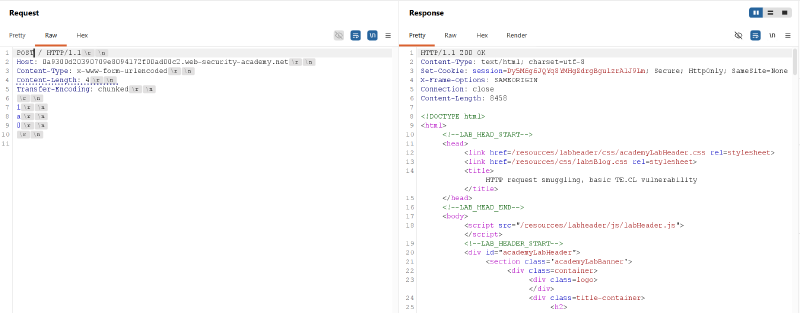
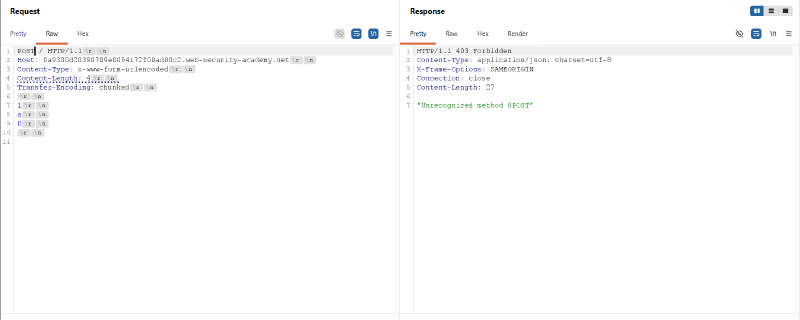
Immediately send a second request across the same connection. The residual 0\r\n\r\n data in the buffer prepends to the incoming POST / HTTP/1.1 request line, producing 0POST / HTTP/1.1. The back-end returns a 403 Forbidden error with Unrecognized method 0POST:
| |
This response confirms the presence of the TE.CL vulnerability.
3.2. Constructing the Payload and Smuggling the GPOST Request#
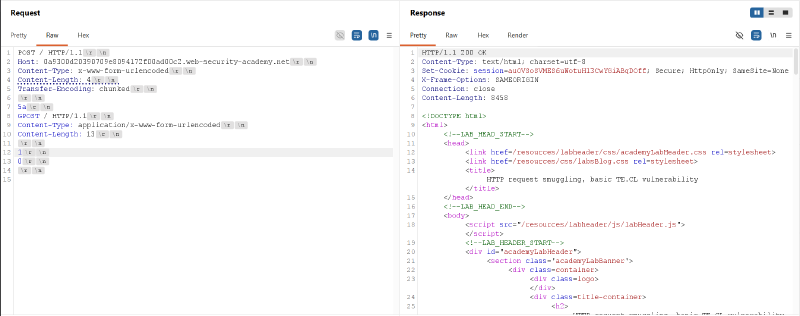
Upgrade the payload to smuggle a complete GPOST request prefix into the back-end socket buffer:
| |
Exploit payload breakdown:
- Chunk Size 5a: Hexadecimal
5adenotes a chunk length of 90 bytes in decimal, precisely enclosing the embeddedGPOSTrequest. - Smuggled Request Body: Contains the request line
GPOST / HTTP/1.1, relevant headers, and aContent-Length: 13header designed to consume the prefix of the subsequent incoming request. - Terminating Chunk: The trailing
0\r\n\r\nserves as the chunked terminator for the front-end parser. - Back-end Interpretation:
Content-Length: 4covers only5a\r\n. The back-end concludes request 1 immediately after parsing this chunk length line, stranding everything fromGPOSTonward in the socket buffer.
Dispatching the exploit request returns an HTTP/1.1 200 OK status code.
3.3. Triggering and Verifying the Smuggled Request#
Send a second request across the pooled TCP connection. The back-end consumes the buffered GPOST / HTTP/1.1 prefix first, encounters the invalid method, and responds with 403 Forbidden:
| |
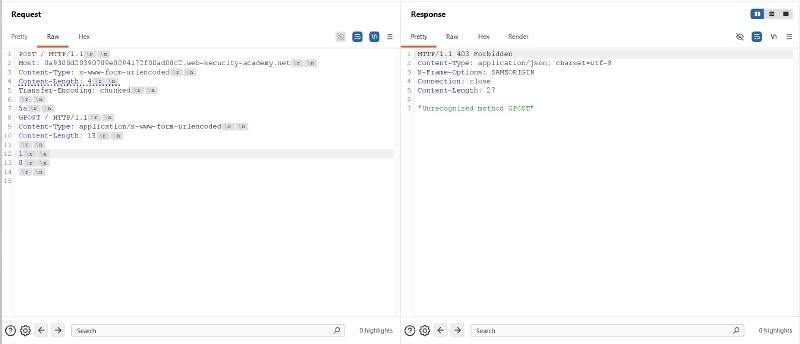
With the GPOST method processed on the backend server, the platform marks the challenge as solved.

4. Remediation Strategies#
To mitigate TE.CL HTTP Request Smuggling, organizations should implement comprehensive architectural and configuration countermeasures:
4.1. Comprehensive End-to-End HTTP/2 Migration#
- End-to-End Binary Framing: Enforce HTTP/2 across all tiers (Client-to-Front-end and Front-end-to-Back-end). HTTP/2 encodes message lengths within explicit binary frame headers, eliminating parsing ambiguity between
Content-LengthandTransfer-Encoding. - Safe Protocol Translation: If reverse proxies must downgrade HTTP/2 client connections to HTTP/1.1 backend requests, ensure the translation proxy strips or normalizes conflicting framing headers before dispatch.
4.2. Reverse Proxy Request Normalization and Header Sanitization#
- Drop Conflicting Headers: Configure the front-end reverse proxy to reject requests (via
HTTP 400 Bad Request) that specify bothContent-LengthandTransfer-Encoding. - Payload Dechunking: If forwarding chunked payloads to legacy back-ends that lack chunked encoding support, configure the reverse proxy to unpack all chunks into a contiguous payload and compute a verified
Content-Lengthheader while removingTransfer-Encoding.
4.3. Back-End Server Hardening and Connection Isolation#
- Strict RFC 7230 Adherence: Update backend web server runtimes and libraries to conform to RFC 7230 section 3.3.3 by ensuring
Transfer-Encoding: chunkedalways takes precedence overContent-Length. - Connection Pooling Isolation: Restrict backend connection pooling or isolate connections per client session to prevent request pollution from impacting concurrent users.