
Challenge Overview#
- Challenge name: HTTP request smuggling, confirming a TE.CL vulnerability via differential responses
- Category: HTTP Request Smuggling
- Level: Practitioner
- Objective: Smuggle a request to the back-end server, so that a subsequent request for
/(the web root) triggers a 404 Not Found response.
1. Fundamental Concepts#
HTTP Request Smuggling via TE.CL desynchronization represents a sophisticated transport-layer vulnerability occurring in multi-tier web architectures where the front-end reverse proxy and the back-end application server disagree on how message boundaries are calculated.
1.1. Architectural Discrepancy in TE.CL Systems#
- Dual Framing Standards: Under HTTP/1.1 specifications (RFC 7230), requests can specify their payload length either via
Content-Length(fixed byte count) orTransfer-Encoding: chunked(dynamically sized blocks terminated by a zero-length chunk0\r\n\r\n). - The TE.CL Divergence: In a TE.CL environment, the front-end proxy prioritizes
Transfer-Encoding: chunked, reading until the terminating zero-chunk. Conversely, the back-end server ignores or fails to parseTransfer-Encoding, relying strictly on theContent-Lengthheader. - Connection Multiplexing Impact: To optimize latency, intermediate proxies maintain persistent, multiplexed TCP connections to the back-end (HTTP Keep-Alive / Connection Pooling). Discrepancies in boundary demarcation cause bytes belonging to one request to spill into subsequent requests sent across the same connection stream.
1.2. Differential Responses Verification#
- Limitations of Syntax Corruption: While basic exploit proofs may intentionally corrupt an HTTP method (such as injecting
GPOSTto provoke a 400 Bad Request or 403 Forbidden), such syntax errors can be caught prematurely by WAF inspection or discarded by web servers without confirming backend application execution. - Definitive Proof via Differential Responses: The Differential Responses technique provides conclusive proof of request smuggling. By smuggling a syntactically valid request targeting an endpoint that produces a distinctive status code (such as
GET /404 HTTP/1.1), the attacker forces an otherwise normal, benign subsequent request to receive a 404 Not Found response instead of 200 OK. This stark divergence proves beyond doubt that the smuggled request was executed by the application backend.
2. Attack Model & Architecture#
The TE.CL differential response attack model requires precise byte-level engineering. The outer request must appear as a complete, valid chunked stream to the front-end, while presenting a minimal Content-Length to the back-end, leaving the nested request waiting in the back-end buffer.
| |
2.1. Attack Data Flow#
- Step 1 - Smuggling Probe Transmission: The attacker sends an HTTP/1.1 POST request containing both
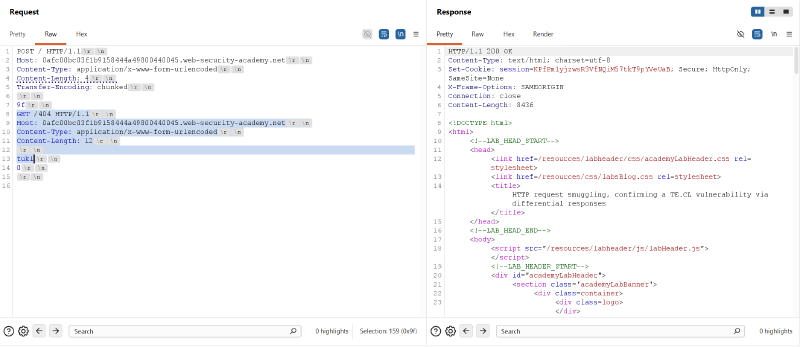
Transfer-Encoding: chunkedandContent-Length: 4. The body contains a chunk size line in hexadecimal (9f\r\n), followed by the smuggled requestGET /404 HTTP/1.1, a Host header, an oversizedContent-Length: 12, a short body prefixtuki\r\n, and the terminating chunk0\r\n\r\n. - Step 2 - Front-end Stream Forwarding: The Front-end parses the stream using
Transfer-Encoding: chunked. It processes the large chunk of length 0x9f (159 bytes), validates the terminating chunk0\r\n\r\n, deems the request fully complete, and forwards the entire byte sequence across the pooled TCP connection to the Back-end. - Step 3 - Back-end Premature Request Termination: The Back-end parses the stream using
Content-Length: 4. It reads exactly the first 4 bytes of the body ('9','f','\r','\n'), considers the primaryPOST /request fulfilled, processes it, and returns an initialHTTP/1.1 200 OK. The remaining 159 bytes remain unread in the back-end TCP socket receive buffer. - Step 4 - Buffer Poisoning & Holding State: The Back-end begins reading the next request from its buffer, which starts with
GET /404 HTTP/1.1. It reads the headers, includingContent-Length: 12. Crucially, the remaining bytes available in the buffer (tuki\r\n0\r\n\r\n) account for only 11 bytes. Since12 > 11, the Back-end is short by 1 byte and halts execution, waiting for additional data without emitting a response. - Step 5 - Triggering the Differential Response: When a subsequent normal request arrives from a client (e.g.,
GET / HTTP/2), the Front-end reuses the healthy, idle TCP connection. The Back-end immediately consumes the first byte of this new request to satisfy the 12th byte of the pendingGET /404body. The Back-end executesGET /404 HTTP/1.1and returnsHTTP/1.1 404 Not Foundto the front-end. - Step 6 - Victim Impact & Delivery: The Front-end receives the
404 Not Foundresponse and delivers it to the user who requested the root page'/', completing the exploitation.
2.2. The Critical Necessity of an Oversized Content-Length#
A vital technical insight in TE.CL differential response attacks is why the inner smuggled request MUST have an oversized Content-Length (e.g., 12) rather than an exact match of the buffered bytes (e.g., 11):
- The Danger of Exact Content-Length: If
Content-Lengthwere set to 11, the Back-end would have all 11 bytes (tuki\r\n0\r\n\r\n) immediately available. It would executeGET /404instantly and transmit an unsolicited second response (HTTP/1.1 404 Not Found) back to the Front-end. - Front-end Pipeline Desynchronization: The Front-end only forwarded ONE request from the attacker, so it only expects ONE response on that connection. When an unsolicited “orphan” response arrives with no pending client request, the Front-end detects a critical protocol violation / pipeline desynchronization error, immediately drops the 404 response, and tears down the TCP connection.
- The Suspension Mechanism: By setting
Content-Lengthto 12 (exceeding the available 11 bytes), the Back-end is forced into a suspended state. No unsolicited response is sent, the Front-end maintains the connection in its active pool, and the trap is sprung cleanly when the next request arrives.
3. Vulnerability Exploitation#
The vulnerability was confirmed and exploited using Burp Suite Repeater through protocol inspection, precise chunk size calculation, connection poisoning, and differential response verification.
3.1. Baseline Protocol Inspection#
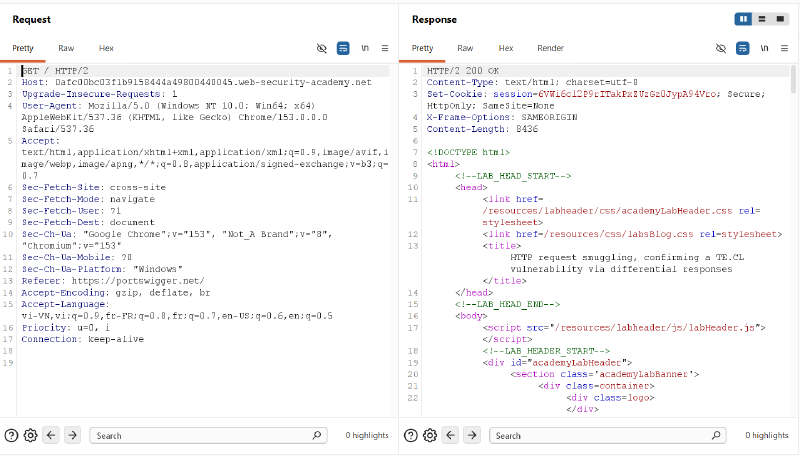
Initial interaction with the lab showed that modern browsers and Burp Suite negotiate HTTP/2 by default via ALPN. Sending a baseline GET / request yielded an expected HTTP/2 200 OK response.
3.2. Constructing the TE.CL Attack Request#
To craft the attack, protocol versioning in Burp Suite Repeater was switched to HTTP/1.1 under Request attributes, and the Update Content-Length setting was unchecked to preserve manual length values.
The attack payload was engineered as follows:
| |
Technical verification of payload metrics:
- Outer Content-Length: Set to 4, covering precisely
'9','f','\r','\n'. The Back-end terminates Request 1 immediately after these 4 bytes. - Hex Chunk Size Calculation: The block from
GET /404throughtukimeasures exactly 159 bytes. Burp Suite’s selection inspector confirmedSelection: 159 (0x9f). - Mandatory Host Header: Included to comply with RFC 7230 back-end requirements, preventing a 400 Bad Request error.
- Holding State Metric: Set to 12. The trailing data
tuki\r\n0\r\n\r\nprovides 11 bytes. Requiring 12 bytes forces the back-end to pause until the next incoming request supplies the final byte.
3.3. Execution and Differential Response Confirmation#
Sending the attack request resulted in an immediate HTTP/1.1 200 OK response. The Front-end transferred all chunked data, while the Back-end processed only the outer request, leaving the GET /404 request primed inside the socket buffer.
A standard GET / HTTP/2 request was subsequently dispatched to the application. The Front-end routed this request over the poisoned backend connection. The Back-end consumed the incoming bytes, fulfilled the pending GET /404 request, and returned an HTTP 404 Not Found response containing the JSON body "Not Found":
| |
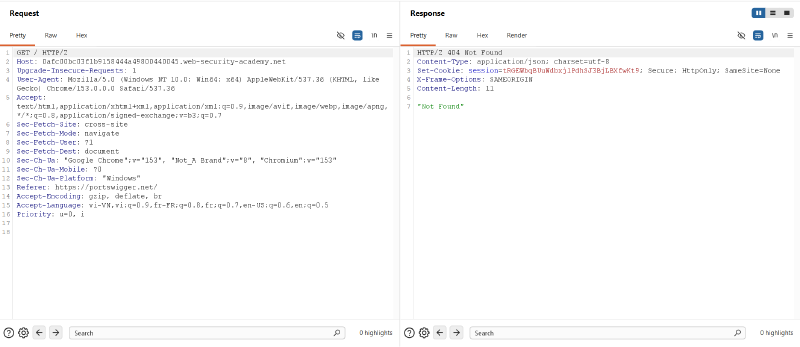
The reception of a 404 Not Found response for a root endpoint request conclusively verified the TE.CL vulnerability. The Web Security Academy platform confirmed the lab was successfully solved.

4. Remediation & Prevention#
Preventing TE.CL Request Smuggling requires rigorous architectural and configuration controls across the entire web infrastructure:
4.1. End-to-End HTTP/2 Implementation#
- Native Binary Framing: Implement HTTP/2 natively across all proxy and application tiers (Client-to-Front-end and Front-end-to-Back-end). HTTP/2 uses unambiguous binary framing that inherently eliminates text-based length interpretation discrepancies.
- Eliminate Protocol Downgrading: Avoid HTTP/2 protocol downgrading at the reverse proxy. Translating binary HTTP/2 frames into HTTP/1.1 text streams when routing to back-end servers frequently introduces desynchronization vulnerabilities.
4.2. Upstream Header Validation and Normalization#
- Reject Ambiguous Header Combinations: Configure front-end reverse proxies (such as Nginx, HAProxy, or Envoy) to reject any incoming request containing both Transfer-Encoding and Content-Length with an HTTP 400 Bad Request.
- Enforce Authoritative Length Normalization: Ensure the reverse proxy normalizes all forwarded traffic: if receiving chunked requests, completely decode and buffer the body, compute an authoritative Content-Length, and strip the Transfer-Encoding header before forwarding to back-end services.
4.3. Back-end Server Hardening & Connection Isolation#
- RFC 7230 Compliance: Ensure back-end application servers strictly follow RFC 7230 Section 3.3.3: if both headers are present, Transfer-Encoding MUST take precedence over Content-Length. Application servers must never silently discard Transfer-Encoding in favor of Content-Length.
- Connection Isolation: Disable internal TCP connection pooling across untrusted client boundaries, or restrict connection reuse strictly to authenticated, single-user sessions to prevent cross-tenant request interception.